Conflicted Holiday Recollections

The holiday commercials and Hallmark movies have started. You know the ones: loving couples presenting each other expensive cars in snowy driveways, smiling families in matching jammies caroling around exquisitely trimmed spruce trees, tykes in designer ensembles waxing adorably poetic on Santa’s lap, true love finding its way to the nearest perfect size two blonde with blindingly white teeth. You can practically smell the peppermint infused cocoa wafting out of your flat screen.

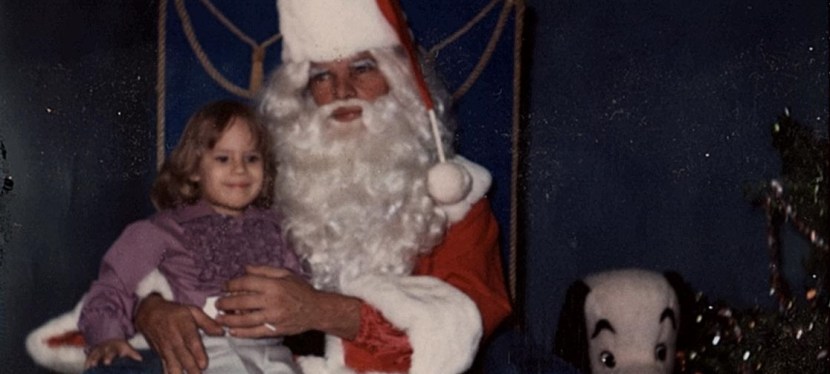
You know what, though? For a lot of us, Christmas doesn’t look anything like a made-for-TV movie or an Instagram post. For a lot of us, Christmas is just one more traumatic day of disappointment or painful memories. My holidays now are awesome and full of love. But it was not always so.

From the outside my early childhood must have seemed picture-perfect—cute suburban house, late-model car, accountant dad and homemaker mom. All of us handsome, all of us dressed in pretty clothes, living in the cute, newly furnished abode of the young married.

My early years were punctuated by childish giggles and my father’s big belly laugh. I know this not because I remember it, but because I have seen photos of myself with my parents and the first of my two younger brothers:

sitting atop my young father’s shoulders wearing only a diaper as he reclined on our couch;

diving into my first birthday cake, hands first, head topped with pointy cardboard hat;

playing in the surf on Charleston, South Carolina beaches;

cuddling with my brother, Lance, on the couch;

tossing a ball with my mom;

riding our shared Big Wheel;

playing with a puppy in our little apartment on Christmas morning.

These are the little moments that make up our stories, aren’t they?

Their sounds still live in my memory: splashes and giggles, the crunch of big plastic wheels on grey pavement, puppy yelps…
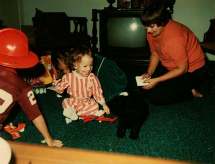
Chad and puppy 1975I was fortunate that in my earliest, toddler and pre-school days, I lived in a healthy and loving family. My mother and father fell in love while attending college in Lubbock, Texas. Having grown up in families that were well-loved and respected in the windy, dusty, conservative town, they had met at the Church of Christ Bible Chair, an inexplicable name for a building near Texas Tech University, where students met to eat snacks, play games, study the scripture, and find spouses.

When I was young, I spent hours laying on my tummy on our den’s gold shag carpet, poring over each and every page in my parents’ wedding photo album. I especially loved the picture in which my mom looked contemplative as she held her prayer-posed hands under her chin, a slit cut in her white kid gloves, made so that the ring could be put on her finger, clearly visible. My dad looked so handsome in his black tux, and I loved a particular photo of him with all his groomsmen, walking with arms linked and big laughing smiles on their faces. My mom had never stored her dress, so I could go into the closet and pull it from the rod and hold it up to my little body, caressing the appliqued roses and rustle-y organza.

She was beautiful; with big blue eyes, golden olive skin, blonde hair coiffed to perfection, and impeccable style in clothing, she was a knock out who grew even more beautiful in the first years of marriage and motherhood. She had that glow that happy women have.

The only boy among four sisters, my father had served in the United States Navy, which was a matter of immeasurable pride to those very sisters, and rightly so. Dad marched in the band at Texas Tech and graduated with an accounting degree just three months before wedding my mother.

So much joy, so much promise.

Recently, while sorting through boxes of keepsakes in my attic, I found two letters that must have been kept in my grandfather’s belongings, letters that I don’t recall ever having seen. In the first of these letters, written by my mom to her family just two weeks after her nuptials, she tells of all the small joys and travails of a newlywed couple: an apartment without air conditioning, burning her fingers while learning to cook, her fear of ironing my dad’s white work shirts, so sure she would scorch them. In the second letter, the one that cracked through every defensive wall I ever erected, she writes home to tell her family what young motherhood was like. There was such joy in her description of my eating preferences (apparently, I loved green beans) and my irritation with a particular orange bird that swung above my head on my crib mobile. She told of my sleeping habits and my quiet nature. The letter was full of hope, she was brimming with love for her husband, for me, and for the life she was starting.

I know very little about their courtship. By the time I was old enough to hear stories of drive-in movies and malt shop jukeboxes playing Elvis songs, our little family had started to unravel. Laughter was becoming less and less present, replaced by yelling and stony silence. Something changed for my mom. In her mid-twenties, depression and mental illness intervened. Opioid addiction got its hooks into her as she attempted to cope with her demons.

Mom diligently built a network of doctors and dentists from the various suburbs all over DFW. I spent many hours with my little brothers in the back seat of the Pontiac as we visited doctor after doctor, left to mind ourselves in waiting rooms while my mom wove stories of pain both real and imagined so that she could get a hookup with meds. When a doctor cut her off, she found a new one. Back in the 1970s, doctors didn’t seem to be as aware of the substance abuse problem, and it took them a lot longer to realize what was happening, so for years she swallowed these pills, with no one the wiser.

My mom on hydrocodone was not a pleasant woman. She had three basic modes: slurred sloth, benign narcissist, and raging monster. Most of the time she was in that middle place. She could not help us to get ready for school, she could not fix breakfast, she could not do laundry, she could not wash dishes, she could not she could not she could not. I learned to live with this mom, she neglected but she didn’t hurt. I figured out how to make delicacies like Frito pie and tuna casserole, I could open and warm a can of green beans. I made Kool-Aid by the bucket in a blue plastic pitcher, I got my dad to show me how to work the washing machine. I checked in on my brothers at school. I was no mother, but I did my best. And I brought my imperfect best to the raising of my own children and the creation of our own precious and joyous festivities.
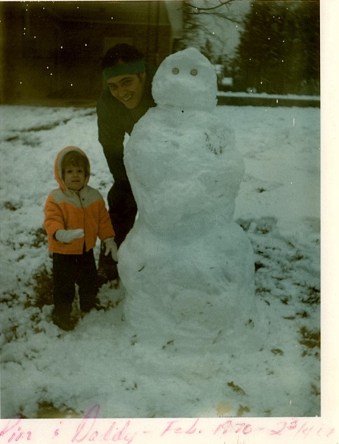
Kim and Daddy 2-70

It’s hard, at holiday time, for me to wax nostalgic about my childhood. The earliest Christmases were all they should have been, I know, but they simply deteriorated as Mom did. So I didn’t bring beloved traditions with me as I raised my own family, I don’t have treasured family keepsakes to decorate my mantel or hang on my tree. Just yesterday, while unpacking all my decorations, I broke a bell saved from my eighth-grade year, a little caroler that had come in a box my choir teacher checked out for me to sell as a school fundraiser. I had two bells left that I couldn’t sell. This was one of them, the only remnants of my own childhood Christmas decorations. My husband held me as I processed, unable even to cry as I said goodbye to a tschotke that held such conflicted significance for me.

With a lot of love and grace, I healed. Now, I look forward to the holidays. But I know it’s sad sometimes, for me. And for others. Take a moment to slow down, see those around you. Notice melancholy. Clasp a hand. Say a blessing. Lend an ear. Withhold judgement. Share a meal. That’s how we can make it truly the “most wonderful time of the year.” Love to all.

dandelion 2


Sometimes, I Am Sad. And Pissed.

I need to be honest, dear reader.

Sometimes, I am sad.

It doesn’t always make sense- what have I to be sad about?

My husband loves me. My children do, too.

My body is healthy, though aging is hard. Joints hurt. Menopause undoes.

I love my home, with its sunlight and hardwood floors and fairy garden.

My bills are paid. Just.

Food is plentiful and I usually eat like I am supposed to- foods rich in protein and low in processed carb and starch. Vegetables. Fruit. I have set aside the old habits of self-medicating with high fructose corn syrup and sugar.

I feed my soul by listening to Super Soul, Rob Bell, and Liz Gilbert, I read a meditation each morning, I peruse stories of empowerment and encouragement over my breakfast of Grapenuts and low sodium V8 juice, hoping to plant seeds in my heart, kernels of courage and contentment.

I exercise, though on sad days, not with much felicity. There is a heaviness to my legs, it’s work to take the steps, not joy. The breath of yoga would make me cry today if I attempted it. Maybe I should do it anyway. Probably should. Definitely should.

I have anxiety medication. I take it.

I have a first world life, with only first world problems.

And yet…I live and breathe with diagnosed and medicated anxiety. Perhaps that’s a first world problem, too? Do women in countries where they must haul clean water in baskets even have time to be anxious? Do they have time for needless worry over credit card balances and cable TV bills? Are they compelled to track calories in a fitness app? Do they fret over every plastic water bottle they see in the hand of a passerby, knowing it might very well end up floating in the ocean?

Relevant and True: Knowing that women in Africa are struggling with weightier issues does not make my anxiety less. It simply does not. We harm others and ourselves when we say: “Look at that person. Her suffering is worse. Buck up.” What we should say is: “I see you. I hear you. I hold you.”

My anxiety is my legacy from my mother, a desperately addicted and acutely mentally ill woman who hurt her own body and the bodies and spirits of her children.

In the days leading up to this melancholy, hands shook. Heart trembled. Breath accelerated. Sleep evaded. Body ached. Soul hurt.

And, dear reader, I will go one step deeper into authenticity. Into the place where good women, sweet women, gentle women, are not supposed to go.

Sometimes, I am angry. Angry as hell.

But this? This, unlike the random bouts of sadness, makes sense to me. I am angry at my past. I am angry at family members who seem to have abandoned me. I am angry at a world in which people can be unkind, dishonest, and abusive and not be held accountable; but are venerated instead. I am angry at a world that believes that Viagra is a legitimate prescription for insurance to cover, but hearing aids for small children are not. I am angry at a country in which walls, not bridges, are solutions, and where millionaire politicians would rather spend money putting guns into schools instead of books and hot lunches.

I am angry because sometimes I feel trapped and confused, and I yearn to walk away; or to find the courage to really say all the things I want to say to those who, from the landscape where I stand, set me aside years and years ago.

I am, on a minute-by-minute basis, endeavoring to live authentically. To be transparent, even amid anxiety and anger and hormones and menopause. To be rigorously truthful in the gratefulness I feel daily for the family I have created, a clan that includes the dear friends who have stood in the gap so often in place of blood.

All of these feelings are as veritably me as those that more usually govern my days- those of joy and hope and creativity.

722d7f22bf0f8b94761be9d616cbc7fe

Last night, I dreamt I was having a baby. My father, who is deceased, was there to calm my worry over the late-in-life pregnancy, as I fretted over my own dangerous, impossible pregnancy and my daughter’s healthy, vibrant one. My subconscious seemed to be bidding goodbye to my fertility, through the precious echo of my father’s voice and calming presence, both of which I miss terribly.

I understand why anger happens. But why does depression happen? I have to be honest- I don’t know. What changed from two weeks ago, when I was I excited about my new camper, career possibilities, and my granddaughter-to-come, who is, right now, about ten inches long inside my daughter’s womb?

Why, in the midst of lovely things, do I isolate myself from friends and withhold myself from family? True, I am an introvert by nature, and so it is way too easy to hole up inside my house. Most of my family of origin is dead, and the one remaining person has little interest in a relationship. He has his own life and loves, and he is very happy in it. Many, though not all, of my most trusted friends are hours away. My stubborn, aching spirit will not call for help. Another legacy of my mother’s, who spent years holed up in her living room, angry, bitter, and heartsick.

Anxiety feels like a rushing river in my veins, something I cannot impede, though I erect dam after dam. It feels like muchness; too much muchness, all quivering inside my fragile shell. It feels like my clenched abdomen and jaw. It feels like darkness and piercing light, all simultaneous.

It feels like fear.

I have spent an entire life with it. I’ve done the self-harm, the mental hospital, the therapy, the religion and its renunciation. I turned a corner. I recovered most of my life, my agency, my courage. I learned to start speaking up sometimes, even when it costs me.

A year ago, I decided to be intentional about what I thought my life’s mission would be, and I started writing about it:

” I believe, down deep in my bones, that life is magical, and that making the attempt to approach each moment with a sense of wonder enables us to live beautifully, no matter our circumstances. I believe that my mission, my personal legend, my work is to help others see, create, and accept the magic of their own lives. I listen. I write. I hope. I pray. I dream…”

Today doesn’t feel very magical, unless it’s a darker magic. A Maleficent kind of magic. Moon magic. Winter in the midst of summer. As I have dug deeply inward, trying to discover whether my moments of rage or sadness make the rest of my life’s message fraudulent, I say no. I am a complex being, with the inescapable right to conflicting emotions and not entirely consistent behavior. I just have to keep coming back to what I know is the core of me: life is beautiful.

Perhaps, it is these intervals of shade that enable me to enjoy the days of sun that I know will come. Today, I will lean into the feelings of sadness. Instead of masking them or eating them away, I will just let them be. I will take a nap, I will move my body. I will talk to a precious friend. I will spend a few moments communing with the Goddess.

And I will trust in fifty-one years of living, when the gray days always gave way to the sunny ones.


No, I Would Not Like To Sit On the Couch, Thank You.

 My first memory of her is a body curled up, sleeping with her back to the living room, South Carolina sunlight streaming in the windows. I was three years old, and my mother was napping. Almost every memory of her after, no matter what age I was, includes a couch.

That first couch was a deep red with a Spanish styled print. I don’t remember that from being three, but from having sat on the edge of that couch right through seventh grade. That couch moved from Tennessee to South Carolina to Texas.

It’s always puzzled me, that couch. Red? My mom loved yellow and orange. Spanish? She hated all things Latin. A shield with crossed swords hung on the wall along with what I think was a painting of a bull fighter or something. The coffee table was a heavy wood with Spanish style turned spindles and doors trimmed in burnished brass. Where in the world did all of that come from?

She liked to call me to come sit on the couch to talk to her sometimes. She might ask about my day at school, what boys I had crushes on. Interestingly, she rarely asked about my female friends. She asked about teachers. She told me that I must go to college.

She lay there and smoked cigarettes, drank Coke or Pepsi with lemon, and watched television for my entire childhood. Soap operas, game shows, and classic horror and sci-fi were her tv of choice. She didn’t mind if I joined her for game shows or “Lost in Space,” but when it was time for “Guiding Light” or “Days of Our Lives” I had to make myself scarce.

She never got up and went to the bed in the bedroom that she shared with my dad in name only. Sure, her clothes hung in a closet in that bedroom, and there was a dresser where she had drawers of underwear and socks and chiffon nightgowns left from her bridal days. But she rarely went in that room. She was on the couch 24/7. One time, when I was about twelve, I got out of bed to get a drink of water and found my father laying on top of my mother on that couch. Sex happened on the couch. Meals happened on the couch. Sleep happened on the couch. Her life was lived on the couch.

Right around my eighth grade year, we bought a new couch: sort of a nubby weave of lime green and golden yellow. I didn’t sit on the edge of that one quite as often, as the divide between my mother and I began to widen. Confiding in her was dangerous- if I shared something I was worried about she would use it against me in an angry moment. Her own depression began to sink her into an apathy of lethargy and sleep.

Perhaps my most vivid couch memory was the day it tipped over. Let me set the scene:

It’s summer, 1979. I am out of school, my dad is at work, and my little brothers are outside playing. My mom seems…off. Her speech is slurred, she’s holding on to the walls as she makes her way to the toilet. I call my dad at work, he asks if I can just stay nearby and keep an eye on things. So I grab a book (most likely a Ramona Quimby story) and catalogs and settle down on the shag carpet for a quiet day of reading and looking at clothes in the Sears Big Book; and I watch.

My mom comes back from a bathroom trip, sits down on the couch, then pitches forward headfirst over the coffee table. Her feet were tucked up under the edge of the couch, so it flipped backward.

Turns out she was completely strung out on pain killers. This was the day we learned about my mom’s addiction.

My mom was…difficult. When she was young, people tell me she was engaging. A tremendously talented athlete. In many ways she was brave- she could face down a speeding softball, catching it and pivoting to throw it to first base in the blink of an eye- this was a gift that I saw a glimpse of when she convinced me to join the church softball league with her during one of the infrequent “good spells.” She was fast as a whippet, graceful on the field despite the numerous broken noses and arms (fearless on the softball field, nothing would stand in the way of getting on base or stopping that ball- not even her face).

She was also beautiful. there are photos that show this to be true, even after she married my dad and had me. Big blue eyes, golden olive skin, blonde hair coiffed to perfection, and impeccable style in clothing, she was a knock out.

But something changed for my mom. Depression and probably bipolar disorder intervened. I say “probably bipolar disorder” because that really wasn’t a thing that was being diagnosed in the early 1980’s. Instead, she was diagnosed as paranoid schizophrenic, which isn’t quite right, but maybe as close as a 1982 psychologist could get.

Women didn’t typically have careers in the late 1960’s and 70’s. They were housewives. I don’t know that my mom found much joy in this. I think she was lonely and bored. It’s not that she didn’t love us. But she was just too sad. So she slept a lot, watched a lot of TV, got depressed, then got addicted, then got crazy. All on the couch.

The last time I visited my mom in her section 8 apartment, where she was living alone, my husband and I slept on the double bed that my grandfather had given her. She said she had tried to sleep on it, but she just couldn’t. She was still sleeping on a couch. This time, an old couch that I think might have come from the Goodwill store. She died when she was living in that apartment.

When we packed it up, my husband and I took the bedroom furniture, but not the couch.

And when I enter a home, friend’s home, or even my own home, I don’t sit on the couch unless there just are not any other options.

A few months ago, I decided I would try to join my husband on the couch- that’s where he likes to hang out. I spent about a week propped up against the arm rest, tucked under a blanket, and having flashbacks to seeing my mom living on her various couches. Not just chilling for a bit, but living. I moved back to my chair.

It’s funny how we are shaped in the strangest ways. An innocuous piece of furniture that exists in nearly every American home can become a subtle, subconscious reminder to me of that child, preteen, adolescent, then young married woman that I was, who observed the long, slow decline of my mom from happy and vibrant young mother to lonely and sad woman. And then, because I can, because somehow I figured out how to step out of her shadow, I rise each day. I sit in an office chair at work, I read in a wicker patio chair in the evening, I watch TV from my comfy chair and then sleep in a bed with my guy every night.

I just never sit on the couch.