

Bell, Book, and Candle: How Books Saved This Lonely Child

School started this week; with students split between virtual and in-person teaching, economic disparity and the limitation of resources for students in the lower socio-economic strata has been thrust into sharp relief. Kids without high speed internet, quick pay Amazon options, or college-educated parents are in a pickle.

I was one of those kids, back in the 1970s, before high speed internet. But the plight was the same. Disparity is a constant, after all.
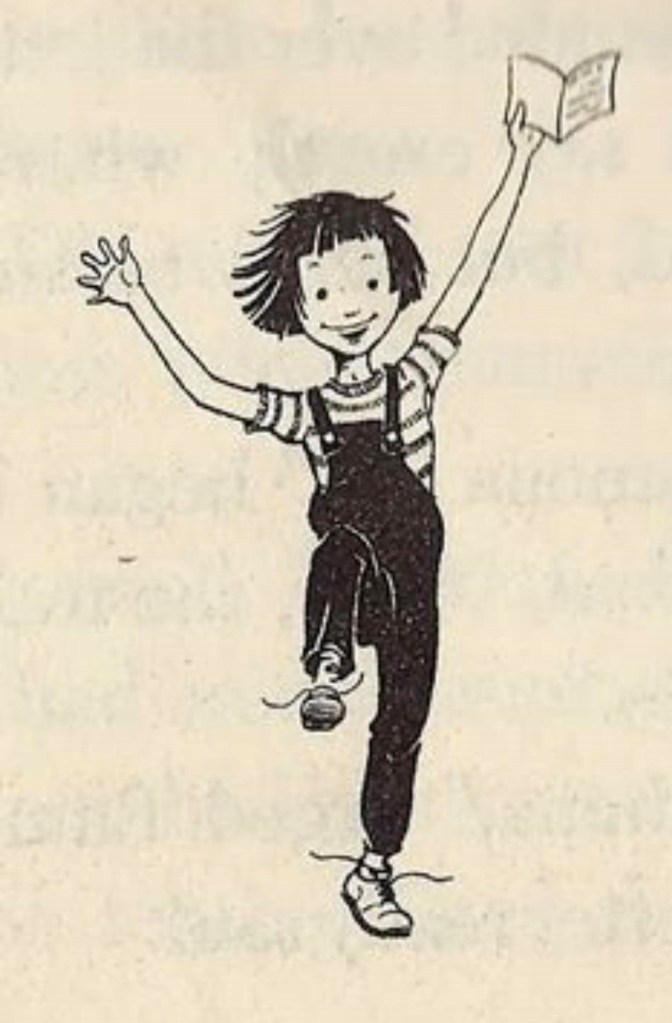
Ramona celebrates a new book.

We didn’t keep books in my house. My parents didn’t read much themselves, and they definitely didn’t read to me. My literacy was fostered by the captions on coloring book pages, Sesame Street, and The Electric Company. Then I discovered the library at school. Ramona Quimby became my best friend in the years when my unbathed, scraggly self didn’t have pals. Beezus was my big sister, Mr. and Mrs. Quimby my parents. Though I never would have dreamed to indulge the sass that lay buried under my compliant surface, it was there. Every time Ramona mouthed off or struggled with her woolen stockings, I loved her. The days at school when we received our Scholastic book order forms were highlights that thrilled me; on newsprint paper was a four-page brochure of paperback books we could order. I saved up, or sometimes my dad had a little spare change, and I proudly turned in my order, anticipating the day a box of books would be delivered to the teacher and I’d have something new and wonderful: with a slick, untouched book cover that would open upon magical words and worlds, I could inhabit every wish I had ever made. Even in the seven years I taught elementary school, I kept up these book orders, bookworm-y teachers love getting new books just as much as bookworm-y kids.

I learned that our town had a portable Book Mobile, a converted bright blue school bus, it was an extension of the town’s public library and traveled to all the elementary schools in the afternoons so that kids who didn’t have transportation to the library could access its wonder. A Wrinkle in Time never had a more devoted follower. I made Mrs. Who, Mrs. Which, and Mrs. Whatsit my own fairy godmothers, Charles Wallace my brother. I imagined visiting other dimensions by tesseract. I wondered what a Bunsen burner was and how a mom could be a scientist.

I saved my pennies for the book fair and bought a graphic novel of Dracula. My maternal grandmother took me to the library when I visited her in New Mexico or, later, at their lake house in Brownwood, Texas, and I checked out Lois Lenski’s Strawberry Girl over and over. It was a summer touchstone, I only read it when visiting my grandma. My paternal grandmother had Encyclopedia Brown books in the den, and I tucked in on the bright orange mid-century linen couch and read when it got too hot to play in the west Texas sun. I wept every time that Old Dan and Little Ann perished at the end of Where the Red Fern Grows.

Once my teachers noticed my voracious appetite for books and looked at my grades in spelling, they realized I could be a contender in the Scripps spelling bee, it’s the one that you still see on television. Now I had a booklet of words to study and learn! I cloistered myself in my pretty yellow room, copying the words over and over with a pencil or recording them in the cassette player my dad had bought as an Amway tool. I carried my booklet with me everywhere, and begged people to quiz me over words.

At the bee, as each word was called, I repeated it, closed my eyes, breathed deeply, and visualized the page. Here was the miracle of my spelling strategy: I could see each page, find the word’s location on it, and, using my finger to trace the letters as my right hand hung by my side, spell it perfectly. I spelled with confidence, emphasizing each final letter with a declarative tone that left no room for doubt. I wasn’t smug, I just knew. I trusted my own voice and my own gift. The youngest girl in the competition, I watched competitor after competitor leave the stage and take a seat at cafeteria tables. Then, a snag.  A problem. A hitch. The pronouncer called out the word “forte,” pronouncing it “fort-ay.” This was not a word that had ever been called to us in our after school practices with Mrs. Goodwin. My brain searched for such a thing on the F page that existed in my memory, but came up with nothing. I asked for both definition and sentence, neither helped. I relied on my phonics comprehension, took a deep breath, and spelled the word phonetically: f-o-r-t-a-y? Ending my spelling on an upward inflection alerted everyone in the room that I was unsure. I waited anxiously, but not for long. They rang that stupid little silver bell. Ding! Neither my homeroom teacher, who had been the coach at school, nor the pronouncers at the table caught on to the fact that the word has multiple pronunciations and meanings, and so one was giving me “a person’s strong suit” and the other was giving me “the musical term meaning to get louder” along with both pronunciations. I was thoroughly lost. When I sat down, I spelled every word to myself, furiously and correctly, for the rest of the contest.

Our bookmobile looked a lot like this one!

You never forget your first spelling bee loss.

As I continued up grade levels, I kept spelling, and I kept winning. When I won the eighth grade bee, and thus the right to move on to the district level competition, the Jackson Middle School newspaper sent a boy to interview me, which he did before the tardy bell rang in English class. We were surrounded by other students, who were listening attentively:

“Why do you think you’re so good?” he asked.

“I don’t know,” I replied. “I guess I just have a knack for it.”

He didn’t recognize the word. He did not have the vocabulary.
“A knack? What’s that? Are you trying to show us how smart you are? How much smarter than all of us?” He laughed. Others laughed. I was both embarrassed and indignant. Why should I have to pretend I didn’t know these words? Why should I have to dumb down my vocabulary, which was extensive, to meet the lower denominator? I learned to be more discreet about my intelligence that day. I didn’t stifle it, my hunger for words was too powerful to ever be curbed, they were the flame that fueled every step, every decision I would ever make. Words, books, stories, they were a candle in the dim shadows.

I kept competing, and winning, in spelling all the way through high school. I even have two adult spelling bee trophies that I treasure. I admit that I mentally correct spelling on social media, and the office has me proof everything.

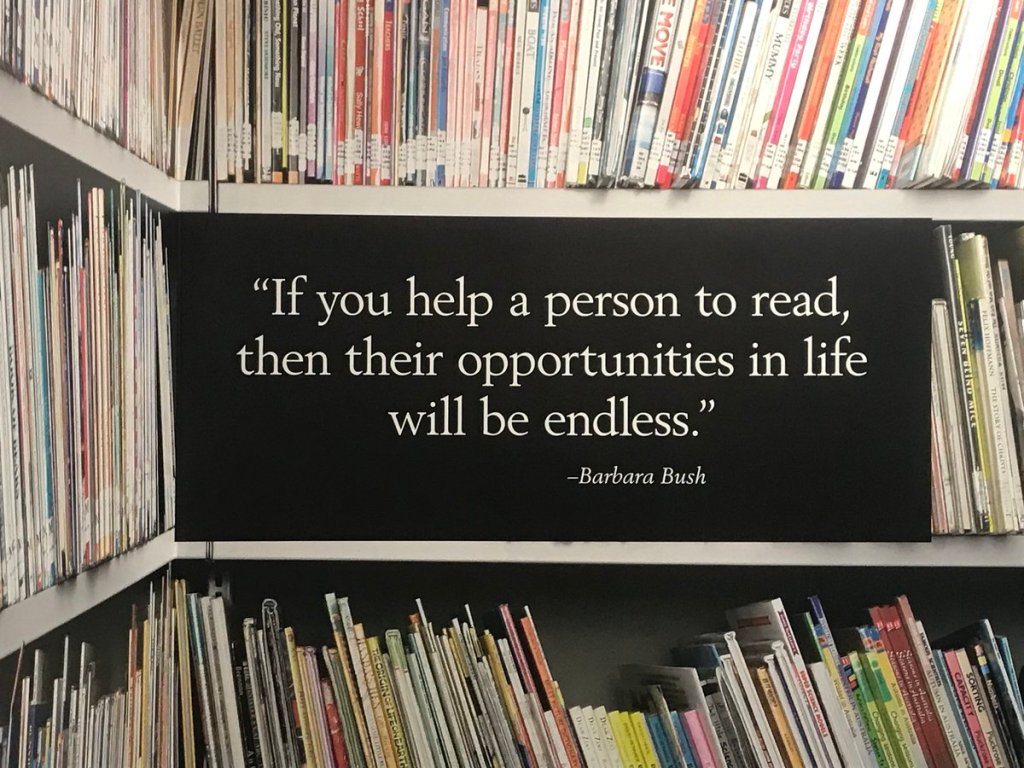
Studies indicate a direct correlation between literacy and mental health. Being equipped to succeed in reading or given the opportunity to develop empathy through identification with a character helps kids to move through the world in emotionally healthy ways. Books and words saved me when I was a struggling kid. They still do, and all of us who are fortunate enough to have easy access to knowledge and its delivery systems owe it to our fellow humans to find ways to share the light.

So, what’s your favorite book?

***

If you’re interested in supporting literacy, here’s a link to the Barbara Bush Houston Literacy Foundation.

https://www.bushhoustonliteracy.org/

Abortion Meets Compassion

About five years ago, I decided to reshape my life. A mental health scare coupled with spinal injury and vocal cord paralysis may bring on the overwhelming need for change, I suppose. When the you-know-what hits the fan in pretty much every area of your life, it’s time to re-evaluate what you believe.

And I decided to believe in compassion; compassion for my own self, and compassion for others. Even, maybe especially, others who make different choices from the ones I would.

That sounds easy, right? Not always, my friend. Nowhere even close. Living a life driven by empathy can sometimes wound. It can occasionally wear you down.

Last night, I had a bit of a rough start to my evening. I was rushing from my full time job in an office to my part time job as a college professor. Traffic had been light, so I had a few minutes to sit in my car and eat an apple while checking in on social media.

Thanks, Facebook.

Here lately, because of a case in New York, there’s been a lot of talk about late term abortions. Talk that hurts.

If you know me at all, if you have heard my story or read my blog, you know that I used to be a devout Christian. I was raised in church. I won the Bible Bee at church camp in sixth grade, I studied Bible at Lubbock and Abilene Christian Universities, I counseled at camp, I spent seven years as a youth minister’s wife, I created the Sunday School curriculum for our entire church in Oklahoma. I physically helped to baptize two of my children. I stood in the shade of my husband’s sunlight, as a good Christian wife was meant to do. I stayed home raising babies as much as possible.

I just love it when a stranger on social media calls me both an “atheist” and an “idiot” in the same sentence before going on to trumpet their own Jesus faith. Pffft. Silly, silly man. Jesus and I go back a long, long way.

In my youth, both spiritual and emotional, I believed all the things a Christian is supposed to believe when it comes to politics. What was it Paul said? When I was young, I spoke like a child…etc.?

In the current American climate, I have come to suppose there are three weighty issues that fuse faith with politics; one’s stance on a wall to keep out illegal brown people is now tied with opposition to abortion for top priority. Putting mandated Christian prayer back into schools seems a distant third.

I only want to talk about abortion though. And how it changes the way people relate to each other.

First, let me get this out of the way: I believe abortion is a tragedy. Always. I never, ever think it’s a thing to celebrate.

When I was eighteen, I was resolute in my understanding that abortion was a sin. An unforgivable sin. So very sure. It was what my preacher taught, and it made sense. Precious sweet embryos need protection. They need a chance to live. They are dear. It was, in my young and certain mind, a black and white issue. “Thou Shalt Not Kill.”

Then a friend, I’ll call her Cindy, found herself pregnant. She had been a fringe youth group girl, we hung out some at devotionals and trips to putt putt, but we went to different high schools. We weren’t close. To be honest, it surprised me when she came to me, imploring me to take her to the abortion clinic in Dallas. I didn’t have a car, but she just needed me to drive her home, in her car.

No one else would help her. She told me then that she felt she could trust me. That I would keep her secret. That I could forgive her. Friends, sisters, that was a crucial moment. I could have condemned her like all her other friends had done. I could have told her she should have just kept her legs closed.

But I thought of Jesus and the woman caught in adultery. How he knelt, how he refused to condemn her. How he said, “Let he who is without sin cast the first stone.” Cindy had been abandoned by pharisees. She needed me to be Jesus. So I took her to the clinic.

I don’t know what I expected, maybe a shadowy, filthy room with cobwebs hanging in the corners and an upside down crucifix suspended over a stone altar engraved with a pentagram? Led Zeppelin’s “Stairway to Heaven” playing backwards over the sound system while men wearing butcher’s aprons cavorted in glee as they worked over the poor women? I was scared to walk into the clinic, though. It turned out to be a well lit, clean doctor’s office. It looked like the same place I had visited my entire childhood to get antibiotics, vaccinations, and lollipops. Cindy ached after it was over. She didn’t cry, but she was very, very, quiet. I got her home and tucked in to her bed, surrounded by stuffed animals.

Just six months later, another close friend had a secret abortion. Pretty much the same reason, and secret because of the derision she knew would be heaped on her. We attended a private Christian college, and sexual purity was literally a requirement for continued attendance at school. The appearance of chastity was the price of admission to our social life. She could not bear the shame, and she would not stigmatize her family.

Did Jesus ever reproach women who were suffering with shame, even if their sin was sexual? Did he ever, ever put limitations on the blessing he offered? I’ll stake my life, there’s no instance in which he ever imposed boundaries on the gift of grace and compassion to hurting people. Self righteous pharisees? Yes. But not hurting people.

Not being Jesus, I still struggled, though. I ached in my soul to think of lives not lived. Embryos terminated. I knew what church taught. The Bible is not specific about this particular situation, and so one has to decide if its prohibition of murder is applicable. I asked my mother in law about it, and was surprised to hear her own thoughts. She supported keeping abortion legal. Surprised is too mild a word, really. I was stunned.

My MIL reasoned that women would have abortions. Period. Always had. Always would. In her heart and mind, to allow a woman to perish due to a misplaced, jagged coat hanger causing uncontrolled hemorrhage was as vile an outcome as the other. To my mother in law, the woman’s life and safety was precious and also worth protection. Pragmatism, yes. Compassion for women? Definitely yes.

I remind you, in case you’ve forgotten the bit I wrote at the top- I think abortion is a tragedy.

In my early 30s, I was staying at a beach house with a group of relatively new friends, and as the night progressed, we started talking about abortions. Several of my friends had had them. Different ages, circumstances, responses, faiths. I began to understand, to really get it: it is possible to have compassion for all the people in the scenario. And in the time that has passed since that night, I have learned of more friends, students, and even family who have trod that lonely sidewalk into the clinic. I don’t think any of us are truly untouched by it.

So that’s the way I have approached the abortion issue since that night. I utterly and unequivocably refuse to sit in judgement of a woman who feels she must have an abortion.

I understand why some people can’t condone the act. I really do. Nevertheless, I believe with all my soul that my heart contains enough compassion for both mother and lost child. Our hearts hold limitless love. It is only when we choose to wall off that love that we cannot meet people in their need.

You know what I don’t understand? When some of those same, supposed Christian warriors call me names. Like “Idiot.” or “Atheist.”

It is incomprehensible to imagine Jesus talking to me like that. It is unfathomable to put Jesus on a street corner shouting obscenities at wounded women entering clinics. And yet, for some, it is their MO. It’s how, in their sense of righteous indignation, they’ve decided to win the race to climb Morality Mountain. They’ve forgotten though, that Jesus isn’t up there. He’s down in the valley, loving on the hurting folks. Even the women who have chosen to abort a child. And so I must, too.