Simplify

Kim 1967- 6 months
The author as a little one

Last night, I went shopping with my daughter, who is expecting her first child (my first grandchild), and watched as she fought off the panic that comes when you’re trying to prepare for a new situation, specifically a baby, and there have been many voices telling you what you need to cover on your baby registry:

car seat, stroller, carrier, mattress, crib, crib sheets, onesies, mittens, diaper bag, changing table, pack and play, organic wipes, ecologically friendly diapers, crib mobile, breast pumps, butt cream, pacifiers, bottles, nipples, tiny socks, and, well, the list goes on.

One particular dilemma that was plaguing her even after we got home was whether to get a baby monitor that would allow her to monitor her infant’s heartbeat by smartphone from wherever she happened to be.
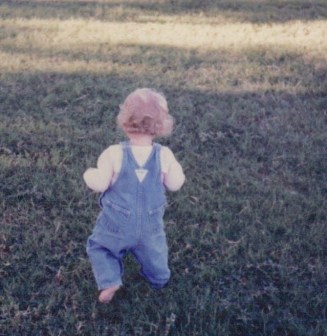
Playtime, Abilene 1995_3
The author’s daughter, she who is expecting her own wee one.

At first thought, this seemed to be a good idea. Then I paused, and really visualized it: if she happened to have an outing with her guy, or maybe a friend, she might just sit, constantly glancing at the app on her phone, not really present with others, not really taking in her surroundings, not really living her life, except in a state of worry.

Perhaps there are times when simplicity is better. So her dad and I spoke of baskets for baby to sleep in, clothing to keep baby warm, car seat to keep baby safe, milk to keep baby fed, and diapers to keep baby dry. And a whole lot of love.

That’s really all you need.

I have been on a mission to simplify my own life, too.

Many of us have seen the book, The Life Changing Magic of Tidying Up.  It’s got a couple of things I already like, right there in the title: magic, and cleaning up. The author’s method is, in summation, to make physical contact with each item in your home. If it brings you joy, keep it. If not, send it away.

I do not like clutter. I might have gone through a phase in the early years of our marriage where gathering belongings gave me a sense of security. If I had stuff, it was evidence that I was doing okay. Then I visited a relative’s home, a four bedroom house with only two people living in it, where every closet was full to the brim, every bed had stuff stashed under it, every room had twice as much furniture as could be maneuvered around, and each surface of that furniture was covered in tchotchkes. I felt claustrophobic. I saw my future. And I reverted back to my true nature, the nature that had kept my childhood rooms neat as pins, with only decorations that had meaning and gave me joy.

Now, if something is in my home, it’s because I love it, it’s beautiful, it makes my heart sing. I don’t keep anything in my house because I feel a duty to do so. My own kids taught me the power of this, they say no if I offer something or other from my house that they don’t want. This was a hard thing to set boundaries against- the passing down of stuff you don’t want, the acceptance of the stuff  just to avoid setting new limits. We had to learn. I am even going through all the boxes of family keepsakes: letters, sepia toned photos, letter jackets, etc. All that stuff is being passed through the same litmus test: Does it encourage love? Does it fill my family’s world with beauty? Is it a part of our family’s story, or the story I am creating of my own life? Does it sing a melody in my soul?

I have been reading the letters that my grandfather wrote to my grandmother when they were courting, and then married, in the 1930s; and simultaneously reading the letters between my own sweetheart and me when we were courting, and then married, in the 1980s. What I am learning is that lovers are pretty much the same. Both couples simply recounted days spent at boring jobs while waiting for the chance to see and hold each other again. My granddad called my grandmother “Hun” a lot. My own guy spent a lot of ink describing each part of my body that he had fallen for. All those letters, representing two generations of married love, are staying with me, sorted into two-gallon Ziploc baggies with cedar balls tossed in for freshness, labeled with Sharpie markers, packed in the same box as the old photos that tell the tale of our two families.

Story is, to me, so magical and precious, it requires a corner of the attic and a corner of my heart.

But my house isn’t the only thing that’s being streamlined; I am working on the whole big picture, too.

Distillation. The dictionary defines it as “the purification or concentration of a substance, the obtaining of the essence or volatile properties contained in it, or the separation of one substance from another, by such a process.”

I am all about it. Distilling relationships, life goals, commitments, hobbies. It’s all going through a metaphorical sieve.

Here’s where I am landing, in these early days of my fiftieth decade:

Quiet is good.

Only friends whose hearts operate in kindness get in close.

Those trusted friends can challenge me to be a better human being.

Sometimes, even family requires careful boundary setting and protective shielding.

Routine is wonderful for a peaceful existence.

Spontaneity is essential for keeping routine from becoming mindless rut.

Travel, travel, travel.

Drink the wine.

Hit the yoga mat. Meditate. Get outside.

Get rid of the scale.

Reduce Facebook time. Read more worthy, nourishing stuff.

Only engage in hobbies that engender joy.

It’s okay to walk away.

My days used to be so full of activity, they were really a whirlwind. I was “The Flight of the Bumblebee” personified. I lapped it up like honey when people said to me, “I don’t know how you do it all. I am so impressed by you!” I didn’t realize, then, that I was burning out. My wings were failing to hold me. I was sustaining myself on a diet of anxiety.

No more. Life is gorgeous when it’s simple; like a magic potion, distilled down to its vital ingredients: love, grace, and reflection.

And also sweet new grandbabies.
dandelion 2


Enough

Right now, it seems like a constant stream of photos of little ones standing in chain link enclosures, sleeping on cement floors, or crying as they are pulled from their parents.

Social media and the news are, rightly, responding to the crisis with unrelenting coverage. I don’t remember this sort of head-on, non-stop coverage of a subject since the days of 9/11.

Over and over, I see memes:

Care for homeless veterans, not immigrants.

Care for American children, not foreign ones.

We can do both. I have said it over and over in Facebook conversations: we are wealthy enough to do both. We have the resources to take care of immigrants, to let them in, to help them transition. They are coming from hellish circumstances that we white American folks have never, ever had to encounter. Ever.

Many policy pundits say it is American policies in Central and South America that have created the very hellish circumstances from which desperate families now flee. We need to own that. We need to fix it. If our policy is to send them home, we are sending them back to the burning building that we helped torch.

We have enough. We have enough. I say it again and again: we have enough.

When you have enough, you share. You don’t hoard.

My life’s purpose has become to foster joy, to recognize how magical life is, to help others see and feel their own magic, and so I keep trying to walk in light. But this situation just hurts. Putting on a happy face feels disingenuous.

I have always had a mother’s heart. It’s the very core of me- this need to mother and love. I cannot watch these families be separated, I cannot hear the frightened wails of these children, and turn away. I will not harden my heart. And I will not stay quiet just so people feel comfortable. Rise up.

These are the two organizations that I have donated to:

http://www.teajf.org/donate/Families-in-Crisis.aspx

Donate

Modesty, Shame, and a Korean Spa

For Mother’s Day, my daughters took me to a Korean spa. This was a wholly new experience for me- I was excited about soaking in pools of warm water and sitting in steam with my two girls. Then I learned something: you have to be naked. Fully unclothed. As a jaybird. Buck. Naked.

I did not handle this well. I had brought my swimsuit- but I was not allowed to wear it. I put on the short green cotton robe that was provided in my locker and just quivered.

I was raised to be modest, and since I was naturally shy, it went hand-in-hand. I am not sure I ever saw my mom naked, maybe once or twice. By accident. I never saw grandmothers in dishabille, even once my grandparents moved to live at a lake, my Grandma June did not wear a swimsuit.

Once, on my first sleepover with a friend, my third-grade self started getting dressed by putting my shoes and socks on with my nightgown. My little friend was puzzled, “Why are you getting dressed like that?” “This is how I always do it,” I replied. The truth was that as she started getting dressed, I was too embarrassed to do the same, so I started with the safest thing: shoes and socks. Of course, once it was time to take off my full length flannel nightgown and put on pants, I had to take off my shoes anyway.

Cover ups were worn to and from the pool, and when I was in drill team we were required to wear cover ups to and from rehearsals. We did not leave a dance rehearsal in our leotards and tights- we covered up.

Shorts were not allowed at school. They were not allowed at church camp- we sweltered in jeans in 100+ degree heat. When I went to college at a conservative Evangelical school in 1985, the same policy held: no shorts except in the gymnasium (no co-ed pe classes), intramural fields, or in the non-public areas of the dorms.

This was the norm in the 1980’s- especially in Dallas, Texas, where the Bible Belt influence is tenacious.

And to be completely honest- I dig a little modesty. I might be a mite old-fashioned, but I feel a jolt when confronted with booty shorts and crop tops. I don’t think I am judging the ladies who dress that way, but I feel uncomfortable, nonetheless. I once saw a really great political cartoon, in which the dichotomy of modesty and freedom in Muslim and Western culture is obvious:

I might fall closer to the figurative hijab or burqa, personally, and the cartoon above really brought it home to me. It’s about perspective, really.

But shame? That’s a whole different ball game.

Confronted with so much female nudity in the Los Angeles Korean spa- a clean, well-lit, secure environment- I could barely lift my eyes, which at moments filled with frustrated tears. I glanced surreptitiously- there were women both fatter and thinner than me, older and younger, darker and lighter, shorter and taller. There were abundant cellulite, lithe limbs, bellies stretched from childbirth, taut tummies, surgical scars, small breasts, large breasts, and in-between breasts. My body would have just blended in. No one would have given me a second glance, yet I just perched on the edge of the hot tub, feet sitting down in the hot bubbling water, robe wrapped tightly and clutched fiercely to make sure it didn’t gap. After a few scorching minutes in the steam room, I curled up on a sleep mat and let the heated floor send me into a sweet snoozy cat nap.

My daughters suffered no such self-shame, by the way.

I have given so much thought to the shame thing- where does it come from? It’s cultural, of course. Ad campaigns, tv shows, blah-blah-blah, on and on. But even more insidious is the way it creeps into the real conversations of the real people who impact our lives.

Like that drill team director who instructed us to cover up as we went to and from the gym or practice field and who also required regular weigh-ins at which all the officers were allowed to sit and comment on our weights as we stepped off the scales.

Once, without realizing I could hear her, a grandmother looked at my photo and commented to my father that I had gained weight. At fifteen, I had been so proud of that photo shoot and had felt very pretty. Until.

On another occasion, while hugging another grandmother tight, she disparaged her own body, saying there was too much too hug, how could my arms reach? I told her I loved her just as she was. Her reply? “Your grandfather would love me more if I could lose some weight.” I was thirteen…

and I believed her because that very grandfather would look out the window at their lake cabin and mercilessly critique the neighbor who, in her 50’s and then 60’s, liked to do yard work in her two piece swimsuit. Her body was fair game, both for its size (which was quite healthy) and its age.

Don’t mistake me- I loved (and still do) all of these grandparents. But somewhere along the way, their comments mixed with church and media messages to create a powerful and addictive cocktail of body and age shame in me.


As the mother of two girls, I tried to be very careful of what I said to them about their own bodies- I wanted them to feel comfortable in their own skins, and for the most part, they do. They didn’t have any problem stripping down to hop in the pools. But what I didn’t realize was that what I said about my own body was affecting them, too. That they were watching. They were listening. They were copying.


When I was visiting in LA just a couple of weeks ago, and I started the litany of body criticism, my older daughter looked at me with exasperation and said, “Mom, please don’t ruin this week with that. Please don’t go there. Please.” It stopped me dead in my tracks- I don’t just hurt myself when I clothe myself in shame. I hurt my girls, who have learned to love themselves, and who love me just like I am. It’s the craziest thing- they admire me. They respect me. And their adult selves have very little tolerance for my self-shame.

I guess body shame and body ownership are two sides of the same coin. I feel empowered when I am a little more modest. Some women are empowered by the burqa. Others are empowered by bikinis. We accept shame when we listen to the voices of the world, and when we let those voices supplant our own.

So, in my own voice, I spent time in my morning gratitude practice saying thank you to and for my body. Part by part: legs, knees, lungs, heart, eyes, mouth, womb, hands, belly…I acknowledged what my body does for me. With me. Sometimes in spite of me.

And just maybe, next time I will get in the naked pool. Maybe.

Mary Oliver’s Poems and Sacred Trees

This morning, I awakened to a gift. A poem that my eldest child, my daughter, sent to me. It was by Mary Oliver. I read it. I was stunned. And then I was intrigued. So I decided to find some more of Oliver’s work. What followed was no less than a descent down a white-rabbit tunnel into a wonderland of beautiful words and exquisite thought. It seemed I had found a poet who spoke to my soul. It turns out Mary Oliver is also a deep-thinking, dream-driven introvert who loves nature, and she has drilled deeply into the questions of Divinity. God’s nature. God’s revelation in nature.

Unitarian Universalist minister and blogger Fred Hammond described it beautifully, and he quoted author Kathleen McTigue as well:

“Kathleen McTigue writes regarding Oliver’s theology, ‘By that word [theology] I mean not only what her poems reflect of her beliefs about God, but what they reflect about a host of other religious questions: What is holy? Who are we? What are we called to do with our lives? What is death, and how do we understand it when we turn our faces toward its inevitability? These questions matter to all of us. And the answers in Mary Oliver’s poems feel so resonant and so true…’”

These are the questions that have become the very litany of my new existence. I now have an empty nest. It’s just me and my husband and our two dogs knocking around the house. I always believed my calling to be a mom was holy. I know it was. But it’s pretty much over. Now I wonder what I am called to in this new chapter. And with each arthritic pain and new wrinkle, I am forced to turn my face toward the inevitable. My parents are gone, my husband’s parents are slowing down. Beloved aunts and uncles seem so much older. These days, my heart is tender. Tears hover behind my eyelids, waiting just out of reach for a bit of tender piano music or the sight of a mother nursing her baby to call them forth, dripping down my lined face.

I have begun to embrace the idea that I am holy, in and of myself. Not my motherhood. Not my wifehood. Not my artistry. Not my vocation. Not my voice. Not even my silence. I am all of those things. All of those things are holy. But even without them, I am holy.

tree 2

And trees are, too.

This poem moved me to tears:

When I Am Among the Trees

When I am among the trees,
especially the willows and the honey locust,
equally the beech, the oaks and the pines,
they give off such hints of gladness.
I would almost say that they save me, and daily.

I am so distant from the hope of myself,
in which I have goodness, and discernment,
and never hurry through the world
but walk slowly, and bow often.

Around me the trees stir in their leaves
and call out, “Stay awhile.”
The light flows from their branches.

And they call again, “It’s simple,” they say,
“and you too have come
into the world to do this, to go easy, to be filled
with light, and to shine.”

tree 4

I love trees. I love them. I just got back from a walk, and the photo above is where I walked: a quiet lane completely enfolded in green leaves and branches. The trees whispered in the spring breeze. Like Oliver says, trees save me. Daily. All my life.

I have always loved trees. The first tree with whom I fell in love was a locust that lived in my neighbor’s yard. My seven year old self, a neighborhood pariah, would climb into the tree and nestle in its branches, eating the little brown beans that grew in pods, watching the kids play without me from the safety of my perch.

My ten year old self adopted the tree in our new house, wedged into the V shape that just fit my scrawny behind, Beverly Cleary and Madeleine L’Engle books nourishing my lonely little soul.

Near my house there was an enormous weeping willow, and I would stand in its fronds, imagining that I was in a safe and magical world where no one could find me. I recently visited that street. Both of those precious trees were gone. I grieved.

In the yard in front of the house where my husband and I  spent most of the child-rearing years of our family, there was a giant oak tree whose leaves created a canopy outside my bedroom window. All of every spring and summer, I felt like I slept in a tree house. I kept a chair on the balcony just outside my bedroom, and when my spirit was angry or in despair, I sat in that chair and simply let the tree speak to my soul. I hugged that tree. Literally. I hugged her. And when we left that house, I had to spend time with her, saying goodbye and thanking her for taking such good care of me.

Psalm 52:8 says: “But as for me, I am like a green olive tree in the house of God; I trust in the lovingkindness of God forever and ever.” I think that oak tree in Shenandoah, Texas was a gift from the Divine One, to show Her lovingkindness for my soul.

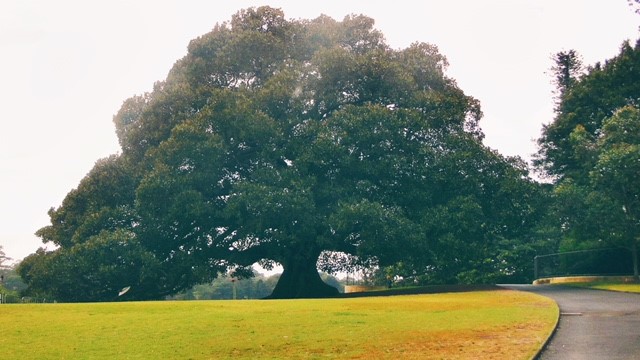
Have you ever seen a giant tree? Maybe a California Redwood? When I visited Sydney Australia with my younger daughter, we found what I think might have been a giant gum tree in the Royal Botanical Gardens. It was stunning. I almost couldn’t walk away. I had to stroke her trunk and talk to her a bit, much to my daughter’s amusement. She’s a bit more pragmatic that her older sister, who balances her chakras and talks to trees like I do.

My daughters, my son, my husband, our parents and grandparents back and back and back have created, as have all families, forests of family trees. Roots go deeper than we can imagine, soaking up nourishment of love like water. Branches reach toward the azure sky and the vibrant sunshine as the seeds of dreams are created and carried. Sometimes there is disease. It might cause a branch to fall, or perhaps even need pruning. That is the great cycle of life that the Divine One has created and set in motion, isn’t it?

What I know today is that my walk amongst the trees fed my spirit, so will the rich poetry of Mary Oliver. Her inner monologues, as revealed in her poetry, just seem to affirm that there are other introverted and tender souls out there who are like me. God has given me my soul, Mary’s poetry, and gorgeous trees to hug. His lovingkindness is everlasting.

Between Shame and Ovation (Thoughts From the Wife of a Former Texas Youth Minister)

Sunday night, after a quiet day of reading and watching television while my husband stayed tucked in bed fighting off a cold, we watched the news together, and looked on in horror and recognition as a story broke about a pastor in Tennessee who had confessed to the 1998 sexual assault of a seventeen year old girl in his youth group. The news program showed footage of Andy Savage apparently remorseful, as he confessed to a megachurch audience. They gave him a standing ovation.

A standing ovation.

I have something to say about all this.

In 1999, living in the very same town (I currently live just five minutes from the church where Savage was a youth minister), my husband was also a youth minister. Though he doesn’t specifically remember Andy Savage, it’s likely they at least attended the same monthly youth minister luncheons that were held at the various churches around our town.

And in October of 1999, my husband stood in front of the congregation and confessed, at three different church services, a sex addiction.

There was no standing ovation.

Thankfully, he never touched a member of his youth group. His struggle was with the fantasy world of pornography and adult bookstores, not with the flesh and blood reality of teenagers.

I will never, as long as I live, forget the glare of the lights and the wide eyes of the church members as we stood on the stage, hand in hand, and Travis told everyone his deepest, darkest secret. This was a move that was required by the church leadership if he wanted to receive a severance salary.

Unlike Andy Savage, whose church leadership demanded silence, both of him and the young lady he abused, our church leadership insisted on full and public disclosure.

I don’t think it is coincidental that last week I downloaded a double episode of Oprah’s Super Soul podcast, with guest Brene’ Brown . The universe was getting me ready to see this story on the news and in my social media feed. Last night, on the way home from work, Brene’ spoke her mantra to Oprah: “You share with people who earn the right to hear your story. It’s an honor to hold space for me when I am in shame.”

As my husband stood in the sanctuary and, in a broken voice, told 2,000 people, most of whom were complete strangers, his darkest struggle, I felt like we had been raped. It was as if our clothes had been ripped from us, and we stood bare for all to see. My children also had to bear the burden of the sidelong (or worse, pitying) looks that were sent their way over the next few months as we struggled to keep attending the church where every room, every person, and every worship service sent us spiraling back into shame. Two years later, when I sat in a therapist’s office and told her this story, she was horrified and told me, in no uncertain terms, that we had been victims of profound spiritual abuse. I have often wondered how many men sat in the pews that morning and breathed great big sighs of relief that their own garage stash or computer files hadn’t been found yet. My husband got to be the whipping boy, the sacrificial lamb, for them.*

Is it any wonder I can’t do church anymore?

There has to be a middle place- somewhere between public shaming and standing ovations. A place where healthy confession is possible, accountability is attainable, and healing is administered for all.

I am beyond thankful that my own husband didn’t ever actually touch a kid in his youth group. We have a close friend, A.,  for whom that was not the case. Earlier in our church work, Travis was compelled to share his struggle with a fellow youth minister who, it turned out, was crawling a similar path. They went to the same support group together. A. didn’t come out unscathed, either. He molested a youth group member.

There’s a lot to think about here: impossible standards of perfection that set young men up for deep, internal sexual struggle; spouses who suffer in silence as they try to raise children and create the model home, knowing that they dare not speak a word because their family’s very livelihood depends on maintaining the veneer of holiness; how to maintain accountability that is safe for both ministers and their charges.

But standing ovations? No. Andy Savage has to make this right with a humble apology to Jules Woodson. She needs healing. Savage and the church leadership must stop making excuses and hiding behind the passage of time. Because I know that if my own experience is any indication, 1998 can feel like five minutes ago. Shame can rear its ugly head at any moment and utterly incapacitate you. I hope Woodson gets the love and joy she deserves. I hope Andy Savage can move forward in honesty. I hope his wife has courage and a couple of love warriors** by her side.

And I hope that his current congregation learns how to support, but not idolize, the penitent minister. I hope they know who the victims are and I desperately hope that they have compassion and love for all concerned.

May the Divine One breathe healing and peace on all of these broken people. And may we all know that we can be broken and healed, as well as being instruments of grace and healing.

*There was one particular family who sat in our shame with us. They listened as we cried, watched our kids while we went to therapy, and never gave us that pitying look. They know who they are, and they are blessedly still in our lives. Most folks just ignored us or tried to pretend nothing weird had happened. I get it- once you’ve seen someone’s nakedess, it’s hard to go back.

**Love Warrior is a phenomenal book by Glennon Doyle. A recovering addict, Doyle was married to a sex addict herself. She knows this journey. I highly recommend this book, which was fortuitously and prophetically given to me this Christmas by my eldest daughter.

Losing My Religion

candle

It’s the day after Christmas. I am sitting in my quiet house, my sweet husband is napping, my eldest daughter and her fiancee have left for a movie, my son is at work, and my youngest is across the world. It has been a wonderful Christmas- everyone is healthy (I didn’t fall and injure myself severely- just one small second degree burn from a candy-making fumble) and happy, and very much in love with their significant other. I don’t feel any post Christmas blues, but the holiday’s passing has left me feeling reflective about one very specific thing: my vanished faith.

I do understand the actual origins of Christmas- Yule and Saturnalia, Pope Julius I’s decision to create a celebration of Jesus’ birth and using the conveniently placed Solstice celebrations to do so, the Puritans’ refusal to acknowledge the holiday (it was against the law to celebrate Christmas in Boston from 1659-1681), its absence in America throughout the 18th century, then its resurgence in the 19th with the publication of Washington Irving and Charles Dickens’ novels.

Historically, Jesus is really not “The Reason for the Season.” But in contemporary America, in Texas, Christmas is very much about celebrating the birth of Jesus.

But not for me.

Amy-Grant

Recently, I had the pleasure of attending Amy Grant and Michael W. Smith’s Christmas concert at the Cynthia Woods Mitchell Pavilion here in the Houston area. I was so excited! It was a chilly night (a rare occurrence in a Houston December), and poor Amy had come onto the outdoor stage in an emerald sleeveless gown. She spent most of act one wrapped in a blanket, and changed into jeans, boots, and a quilted parka at intermission. Smitty was in a suit, and playing pretty vigorously at the grand piano, so he seemed to fare better in the chilled air. I loved it. They sang back to back renditions of “Jingle Bells” (Smitty sang the Perry Como arrangement, Amy the Streisand), “The Christmas Waltz,” and “Rockin’ Around The Christmas Tree.” I have been listening to these two sing Christmas songs since I was 18 years old, and it was like being home.

But the mood changed in the second half. It became more tender, more reflective, more…worshipful. In this half, Amy sang “Heirlooms” and “Breath of Heaven.” Smitty led a sing along. But this was not a sing along like happens at your child’s elementary school PTO program, with “Rudolph” and “Santa Claus Is Coming To Town.” This was “Hark the Herald Angels Sing” and “The First Noel.” The mood became holy. And I couldn’t sing. Clearly, the audience was worshiping, and I knew that to lend my voice would be inauthentic. Counterfeit. It was beautiful, and I felt alien. Throughout the remainder of the concert, I teared up several times; and when the first notes of “Friends” played in the encore, I began to really cry…when the lights went up, I found I couldn’t talk, I could barely hold it together and my sweet husband held me while I wept, truly wept.

Christmas is often a time for heavy-heartedness- that’s not news to most adults (and a few kids). We grieve for lost loved ones. We mourn passing time. I am a little melancholy this year. But it’s not really nostalgia for my childhood Christmases (which were spotty, to say the least). It’s not even nostalgia for the holidays for when my kids were little.

My grief is for my lost faith.

I no longer believe in the Christian faith. Not because of “hypocrites” or the times when God hasn’t answered prayers. Not because of the insanity of millionaire ministers or the rampant suffering and injustice in the world.

I can’t believe a virgin birth. I just can’t. Nor can I believe that a dead man rose and walked after three days entombed. And I can’t force myself to sit in a sanctuary and recite the Nicene Creed or sing hymns (or praise and worship songs) that strike me as so very, very false. It would be, for me, fraudulent, and an insult to the sincerity of the Christians who find such joy in their faith.

I believe in the teachings of Jesus, wisdom of the Proverbs, the passion and pathos of the Psalms. But I cannot accept that many of the writings of the apostle Paul were meant to be followed verbatim, by all humans, no matter gender, culture, and time, for ever and ever amen. I know enough to know that what we have as the Holy Bible was passed around, rewritten, interpreted, and adapted for 300 years before finally being codified. How can it possibly be infallible?

Unusual-Christmas-Trees uses

But secular Christmas seems so empty.

How does one recover from lost faith?

When I posted on Facebook that my thoughts, not prayers, were with the victims of the French terrorist attacks, a long time friend (who is not a person of faith) sought me out two days later to tell me, in person, that that made him sad. That he sensed that the loss of my faith was a grief to me. How profound is it that it was an agnostic to express sorrow over this loss?

That he has expressed more kindness over my loss than nearly any Christian in my acquaintance is also profound. I think I am a pretty big disappointment to a lot of people.

Most days, I don’t really give it much thought. I don’t miss church, not even a little bit. I think years as a minister’s wife, privy to the inner workings of church politics, cured me of ever wanting to belong to a church again. American Christianity has become a frightening place, full of fear and politics.

broken_cross_by_cantabrigian

In her book Quiet, Susan Cain describes the dilemma of introverts (of which I am most definitely one) trying to participate in American Evangelicanism: ” Contemporary Evangelicanism…emphasizes building community among confirmed believers, with many churches encouraging (or even requiring) their members to join extracurricular groups organized around every conceivable subject- cooking, real-estate investing, skateboarding.” She meets with a man who struggles with his introverted nature, and can’t find the place where he can worship, commune, and serve. I get that. In my last attempts at finding a church home, all I wanted was a place where I could have a few real, genuine friends and contemplative, thoughtful worship, preferably far, far away from LED smart lights and Jumbotron screens.

Oh, and by the way, I still believe in God.

So I try to use walking or yoga time to reconnect with the Divine. In my solo worship time, I have learned that God is also Goddess. That trees and animals carry a bit of the Divine spark. That literature and music do as well. I have learned that kindness can be found and is often practiced by the most unexpected people: the tattooed, gypsy “heathen” is often more benevolent than the most polished Evangelical.

Years ago, when I confided to two of my aunts (on my mom’s side) that I had found myself in a desert place, they assured me that if I was just patient, that God would lead me out of the desert. I don’t feel arid anymore, and that’s a blessing. But I don’t feel Churched, either. I feel like I am in a quiet forest, with a beautiful lake. Pretty alone, but with something Divine whispering to me. Maybe that’s enough.

Merry Christmas, friends.

Five Things Tinker Bell Taught Me

Tinker Bell is sort of the Paris Hilton of fairies. She’s blonde, pretty much everyone has heard of her, and she can act a bit bratty sometimes.

According to her creator, J.M. Barrie, Tinker Bell is “exquisitely gowned in a skeleton leaf, cut low and square, through which her figure could be seen to the best advantage. She was slightly inclined to EMBONPOINT [a plump hourglass figure].”

Though her voice is the tinkling of bells, she speaks with salty language, calling Peter a “silly ass” when he suggests she be Wendy’s fairy, since he is a boy and can’t have a fairy, and tries to have Wendy assassinated upon entrance to Neverland, telling the Lost Boys to shoot the “Wendy Bird” on Pan’s instructions. When it counts, though, she drinks poison to save Peter from death. She is complex and common, a mender of pots and pans in Neverland.

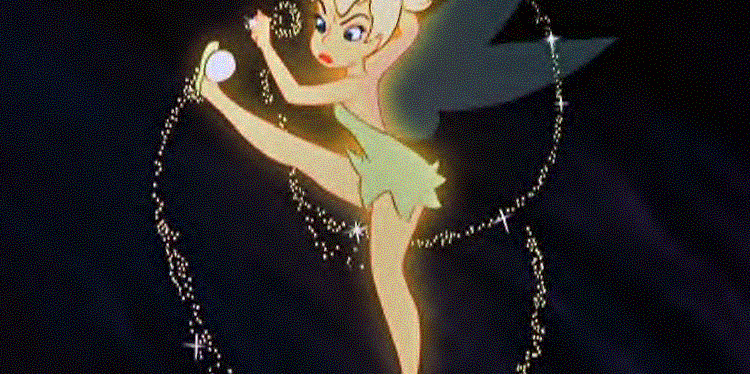
tink 6

I adore her. I adore her in her spoiled diva-ness, her single-minded purpose to be the center of Peter’s world, no matter the tactics required to get there. I adore her little puffy Disney shoes and her leaf green short dress.

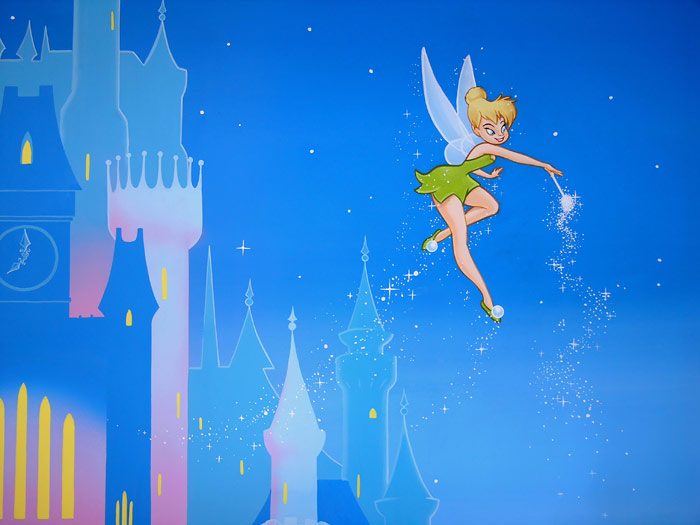
Tink may arguably be the most popular of all Disney females. I know she hasn’t infiltrated the airwaves with a song like Elsa’s “Let It Go,” but she is now the central character of the entire Disney Fairies franchise, she flies over Aurora’s and Cinderella’s castles every night during the Disney fireworks, she even has a 5 1/2 inch replica at Madame Tussaud’s. She flies over the opening credits in Disney films, sprinkling magic over the logo, and her star was the celebratory star on Hollywood’s Walk of Fame 50th anniversary. Tink is legit. I mean, Reese Witherspoon is going to be playing her in a live action film- an Oscar winning actress as Tinker Bell! You can’t get more legit than that!

10562719_10153034049237711_5087829646281846399_o

My daughters and I recently met Tink at her home in Pixie Hollow in Disneyland. There were several cute fairies to be found in Pixie Hollow, along with some very cute scenery. But when we got to Tink, we were like little girls! She was petite and perfect, right down to the puffs on her slippers. Our favorite Tink, however, is angry Tink. We like her saucy and belligerent. This Tinker Bell was so sweet, dainty, and smiling. We asked her if she would mind doing a photo (of course she wouldn’t, that’s what she’s there for), but we asked if she would please do the angry Tink face. She told us she really wasn’t supposed to, that she was to be kind and polite at all times or she’d get in trouble with Peter. But after a quick glance to make sure there were no little ones waiting behind us, she crossed her arms and made a perfect pout.

Tinker Bell, common or not, is a fairy who knows what she wants: Peter’s affection and to be the baddest fairy on the block (or Hollow or island).

As I have stated before in my blog, I didn’t come into my love for all things fairy until I was an adult. I didn’t see Disney’s film of Peter Pan until I was in my late twenties, so my love for Tinker Bell comes from a grown up place. Here are a few things I have learned from Tinker Bell:

Tink 1

1. Have a marketable skill, but look wonderful while doing it! In the Victorian England of Tinks’ creation, a girl might need a job, a way to pay the rent on one’s tiny treehouse. Tinker Bell is a tinker- she mends pots and pans! But she looks beautiful while doing it, she is, after all, wearing a “skeleton leaf.” I have not quite mastered the art of looking fabulous while I work, I am usually in some dowdy pair of capris and flats, with my hair dangling without style. If I could wear wings to work, that would change instantly.

2. Puffs on shoes are always appropros. When I was in junior high and roller skating rinks were all the rage, I saved my pennies for a set of yellow puffs to tie on my skates, they pretty much looked just like Tinker Bell’s shoes in the painting at right. Though they didn’t glow, they made me feel quite invincible on the wood floor, enough that I would teach myself to skate backwards. But not, however, enough that I would work up the courage to ask Rob P. for a couples skate.

3. Being clapped for always makes you feel better. After she has drunk Peter’s poisoned medicine to prevent him from swallowing it and dying, Peter calls on all the children who believe, if they can hear him from Neverland, to clap to resurrect her. The applause enlivens Tinker Bell so that she can be resurrected and go with Peter to fight Captain Hook. I like applause, too. I love coming our for a curtain call and being lauded. And clapping doesn’t have to be literal- a friend or coworker can notice something you did well, a spouse can remind you why he chose you, a child can wrap her arms around your knees, telling you “you’re the best mommy in the world.” Applause comes in many forms, and it makes us feel better.

tink 5

4. Sometimes inappropriate language gets the point across best. When I was a little girl, my mother would not allow the use of the words “fart,” “butt,” or “crap.” Or, for that matter, “darn.” Hard to imagine, right? I clearly remember the first time I said “butt.” I was on the playground in fifth grade, we were seated on the blacktop, lined up in classes to walk back into Sally B. Elliott Elementary School. I looked around to make sure no one was paying attention to me (I don’t know why I bothered, I was ever the Invisible Girl), then whispered behind my cupped hand: “Butt!” When lightning didn’t strike, I said it twice more. As I moved through junior high and high school, I occasionally dusted my sentences with a choice naughty word. After my husband left ministry, I decided that one of my new-found freedoms would be the occasional cussword, in appropriate social settings. Now, I know some will disagree with me, but I think strong language can be empowering. I am tired of women being expected to talk pretty and sweet all the time, damn it.

Tink 2

5. Fight and sacrifice for the one you love. I don’t condone the pulling of hair, like Tinker Bell did to Wendy, nor the attempted assassination. But props to Tink for doing what she felt she had to to protect Pan. The heart knows what it wants. Tink loved Peter, and no other girl was interfering with that. When Hook poisoned Peter’s medicine, Tink drank it herself to keep Pan from dying. There are people in my life whom I love completely without reservation or hesitation. Not only my husband and children, but other family members or dear, dear friends. I think that to love and be loved so completely is magical, no fairy dust required.

It takes faith to fly. Faith in one’s own self, in one’s dreams and aspirations, in the universe that holds us. J.M. Barrie, Tinker Bell’s creator, had this to say about belief: “For to have faith is to have wings.” It has taken me long years, but I hope that my wings are finally sprouting.

Let’s Go Fly A Kite!

Daddy and me, 1970I believe kites are dreams. I mean, really, when you’re flying one, don’t you feel as though you’re floating alongside it, aloft like a dandelion seed, rising and falling on unseen wafts of air? I have not flown a kite in years, but I used to love to send a kite up into the air, running with the string, giving it slack or yanking it taut to keep it soaring.

My daddy loved to fly kites. When I was a kid, he would sometimes bring an armful of newspaper to the kitchen table and call me and my brothers into the room. We gathered scissors and tape; I would usually decorate the kite, and Daddy always stressed the importance of the tail. On other occasions, Daddy would see a kite at the store and on impulse, he would snap it up and take it excitedly to the cash register. This was a real splurge for us, money was always scarce. I think maybe Daddy bought kites when he was feeling discouraged and needed a lift.

Perhaps kites are prayers, too. Though always a man of faith, church was not something my daddy attended regularly. I am not sure what his personal faith journey was, I know there were some devastating hurts inflicted by well-meaning but misinformed church leaders. I know that in my own arrogant twenty-something faith years, I probably landed a few good blows, too.

Perhaps my daddy sent kites up when he wanted to connect with the Almighty;  by shifting his focus away from the heavy gravity-soaked earth under his feet and onto the vast expanse of blue sky, he could send a little whisper to God on the breeze. I like to believe that God whispered back.

The year my daddy turned fifty, I learned something new about him. While visiting us for Christmas, he and I stayed up late to chat in the living room speckled with tree-light glow, whispering so we didn’t wake my sleeping toddler. He told me, for the first time, that he had always wanted to be an Air Force pilot, it had been his aspiration throughout childhood. When he applied for the Air Force, his eyesight prevented him from being accepted into flight school, so he went to the Navy instead.

Maybe for him, kites were also Air Force jets.

Anyway, once our kite was ready, Daddy would load us three kids in the car and we’d head to a field, usually at the nearby elementary school, and we would fly our kite until it broke or darkness fell. Those are some of my favorite memories with my dad and my two brothers.

11427195_10152818410851097_4664171811351207828_nRecently, my eldest daughter, Hilary, posted a photo on Facebook of she and a friend flying kites on the beach in California. She’s another dreamer, off in L.A. pursuing a career in film, putting away doubts and only listening to voices that encourage. I love that image- sun, sand, kites aloft, and my daughter’s smile.

My daddy was not the only one who loved kites. The Chinese are credited with inventing them thousands of years ago. The Afghan people fly kites competitively. Khaled Hosseini’s novel The Kite Runner is an exquisite chronicle of a father and son who run after fallen kites.

When I taught junior high theatre, there was always a day after standardized testing when the kids took the kites they had been building in math class out to fly. The halls were filled with such laughter and excitement– flying a kite is way better than sitting at a desk doing endless formulae, and I know that flying their very own colorful creations is probably one of their favorite school memories.

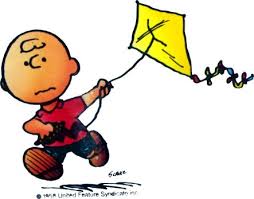
Charlie Brown

Poor Charlie Brown never could get his kite up past the kite-eating tree. Dreams denied, indeed. The classic loser can’t fly a kite.

And then there’s the classic Disney film Mary Poppins.

I always cry at the end of the movie. Somehow, the Sherman Brothers, who wrote the song for Walt Disney’s film, perfectly captured the joy that comes when you fly a kite. With its lilting melody and hopeful lyrics, a kite lover can close her eyes and remember exactly how it feels to send a kite soaring, all at once “lighter than air.” In that film, the kite is a symbol of a healing family: “Up, through the atmosphere, up where the air is clear, come, let’s go…fly a kite!” A family needs a moment when the air is clear. So does a dreamer, or a God seeker, or a middle-aged former teacher who wonders at every turn what in the world she’s supposed to be doing.

Mary Poppins kite

Life is kind of like kite-flying, I guess. Wind dictates direction, sometimes we go in ways we never envisioned. The glass-covered strings of our enemies can cut our own fragile strings and send us plummeting to earth, shattered and broken. Hopefully, a kite runner, maybe a loving family member or an attentive friend, occasionally even a random stranger, picks up our damaged kite and, with glue and tape and love, puts us back together so we can give it another go.

All this talk of wind and adventure and dreams has made me want to go kite-flying. I’d better go find tuppence for paper and string. Time to build my own set of wings.

dandelion 2