Mom of a Different Time

On a Sunday in early May, what I thought was an early birthday brunch ended up being the day I found out I am to be a grandmother.

This is not a title that sits comfortably on me. In fact, I have been dreading it for years, relieved that my older two kids planned to have kids much later if at all, and assuming the youngest would at least wait until she was married and settled.

The Universe has a sense of humor, though. What I have been planning is five years of travel and adventure and completely obligation-free Saturdays, weekends for sleeping in and drinking mimosas. Maybe with my daughter.

Now I am looking at a complete shift in identity. I am now “Grandma.” I utterly and unequivocally refuse that title. Perhaps I will be “Nonny” or “Lolly” or some such thing. But not “Grandma.” I couldn’t bear it.

I have several friends who are already grandmothers. They post sweet photos of squishy little faces, all cuddled up in Grandma’s arms. They have, you know, shirts that say grandma stuff. They swear it’s awesome. The best thing ever. Pure Magic. Which, of course, what I try to live, a purely magical life.

I had grandmothers. I had two completely beautiful grandmothers. You know what they were, though? Old. They were old. To a little girl, they looked ancient. I don’t want to be seen as ancient.

When my daughter and her beloved left our house that spring day, I told my husband as he held me, “I am not ready to be a grandmother.” His reply? “Are you ready to help your daughter be a good mother, though?” Yes. Yes, I am.

And so, after a few days of mulling, I got excited, really excited about the sweet little peanut who will come into our lives soon. I am in love with this baby. I talk to my daughter’s tummy; I stare longingly at other infants, so anxious to hold this one am I; I window shop in baby departments, and I have a countdown to due date app loaded on my iPhone. I felt her flutter, and that was an enchanted moment like nothing I’d ever felt.

Grandmother…and yet, still mother.
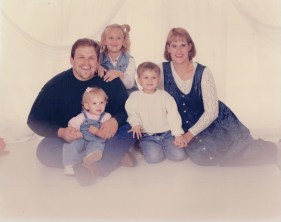
Spring, 1995(2)

Motherhood of young adults who are in their twenties is a whole different level of parenting. Skinned knees give way to broken hearts. Allowance shortfalls are now being unable to quite make rent. Not getting along with an algebra teacher has morphed into coaching an adult child how to deal with an abusive work relationship. Romances have moved beyond the land of “check yes or no if you like me” into the complex realm of co-dependence and infidelity.

Of course, the first step of this change is the college experience. With each child, I worried when we dropped them off at their dorm rooms. With the eldest, our consternation was much about her roommate, a reclusive and unfriendly gamer chick who stayed up late into the night, keeping Hilary awake and groggy. We worried whether she was making friends (she was), partying too much (she wasn’t), and studying enough (she most definitely was). I fretted about bugs in her dorm room and the quality of the food offered on her meal plan. I worried whether she would have the stamina to sustain her choice of major as she worked her way through the grueling audition process that is collegiate theatre. Eventually, she bought a car, changed boyfriends, and started being cast in phenomenal roles that challenged her as both artist and woman.

And yet…she fell deeply in love with a young man who played her romantic love in a play, and we watched as fantasy became reality. Red flags were showing everywhere, and her father saw them almost immediately. It took me a bit longer, though. Our daughter was in love with a drug addict. As a parent, you’re almost helpless. I would say it just  feels like you’re helpless, but it’s actually true. You’re helpless. We pointed out the dangers: disappearing money, stolen debit cards and checks, evictions and creditors, a totaled car, even jail time for theft. Our daughter was so convinced her love would be enough to conquer all. Until the day it wasn’t, and reality hit her like a tsunami.

All you can do, then, is to hold your daughter close when she needs to cry, give her space for quiet when she needs to think, and the sure knowledge that her family is standing by to help her put herself back together.

Christmas 1995

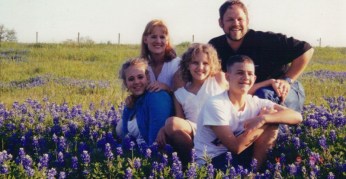
The next child falls into a depressed isolation in his dingy dorm room at the east Texas college that no one told you was in financial crisis and would soon be shuttered, and you begin to question where you went wrong as a parent. You’re sure that your childhood role models of family perfection, Greg and Marcia Brady, never struggled like this at college, that they made it to every class with their shiny hair intact and their books perfectly organized. He’s just far enough away that you can’t get to him easily, and when he comes home, he’s hurt and angry, feeling abandoned, when what you were really trying to do, as a parent, was show him your faith in his independence and courage.

That one also dives deep into a couple of troubled relationships, also sure that his love would be enough to conquer all. Again, Tsunami.
Texas 2

And there’s the baby, who, by luck of the draw, ends up in upper classman apartments instead of a freshman dorm, has a near brush with dorm room forced sex, is panicked by the pressure to choose a major, and so flees to Australia to be an au pair in what turns out to be a house run by an unkind mother who refuses to provide her nourishing food, all the while eating her own Hello Fresh food service meals. If you thought your son was too far to reach, your daughter is even farther. She falls in love with a 38 year old man and stays Down Under for two years, then comes home heartsick, a bit bruised in spirit by what turned out to be a pretty controlling bloke.

Then, thank all the heavens and gods and goddesses, she returns to school and meets a good young man, falls in love, gets pregnant, and makes you a Lolly.

It is so, so hard to bite my tongue when I see my young adult children making decisions that might come back to bite them: car purchases, job changes, lovers, debt…

When my kids were little, my husband and I managed their income, their spending, their friendships, their schooling, their hobbies. I don’t mean we dictated, but we drew boundaries: only two after school activities (to prevent exhaustion), sleepovers only where we knew the parents (to prevent abuse), supervised spending (to stave off wastefulness). We worked to lay a foundation of love and confidence.

Now we watch as they test that foundation. They crack it, but it seems to hold. They move forward, sometimes with grace and sometimes with grief, but always forward. Their love is more precious to me now because it’s been tried and tested in the fires of anger and forgiveness, tug and release, and lessons learned. Not just their lessons, but mine, too.

I have learned to have faith in my children.

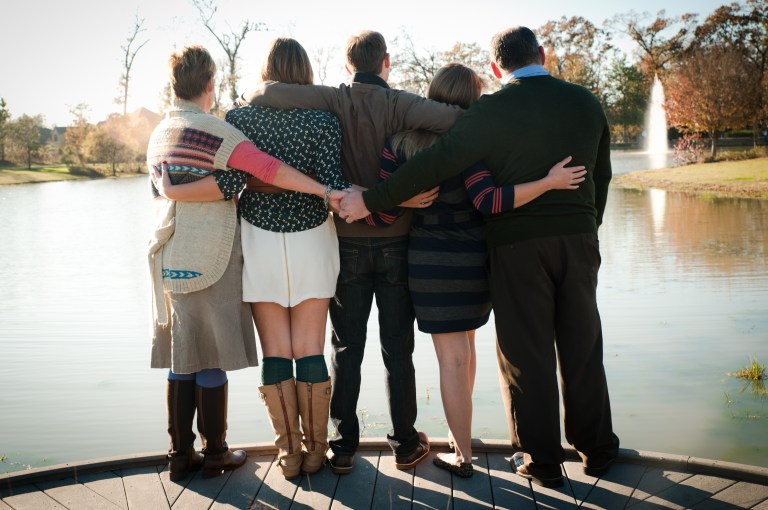
Now, I too move forward. Can’t wait to meet my sweet granddaughter, Hazel Elizabeth.
Back of Family

Sometimes, I Am Sad. And Pissed.

I need to be honest, dear reader.

Sometimes, I am sad.

It doesn’t always make sense- what have I to be sad about?

My husband loves me. My children do, too.

My body is healthy, though aging is hard. Joints hurt. Menopause undoes.

I love my home, with its sunlight and hardwood floors and fairy garden.

My bills are paid. Just.

Food is plentiful and I usually eat like I am supposed to- foods rich in protein and low in processed carb and starch. Vegetables. Fruit. I have set aside the old habits of self-medicating with high fructose corn syrup and sugar.

I feed my soul by listening to Super Soul, Rob Bell, and Liz Gilbert, I read a meditation each morning, I peruse stories of empowerment and encouragement over my breakfast of Grapenuts and low sodium V8 juice, hoping to plant seeds in my heart, kernels of courage and contentment.

I exercise, though on sad days, not with much felicity. There is a heaviness to my legs, it’s work to take the steps, not joy. The breath of yoga would make me cry today if I attempted it. Maybe I should do it anyway. Probably should. Definitely should.

I have anxiety medication. I take it.

I have a first world life, with only first world problems.

And yet…I live and breathe with diagnosed and medicated anxiety. Perhaps that’s a first world problem, too? Do women in countries where they must haul clean water in baskets even have time to be anxious? Do they have time for needless worry over credit card balances and cable TV bills? Are they compelled to track calories in a fitness app? Do they fret over every plastic water bottle they see in the hand of a passerby, knowing it might very well end up floating in the ocean?

Relevant and True: Knowing that women in Africa are struggling with weightier issues does not make my anxiety less. It simply does not. We harm others and ourselves when we say: “Look at that person. Her suffering is worse. Buck up.” What we should say is: “I see you. I hear you. I hold you.”

My anxiety is my legacy from my mother, a desperately addicted and acutely mentally ill woman who hurt her own body and the bodies and spirits of her children.

In the days leading up to this melancholy, hands shook. Heart trembled. Breath accelerated. Sleep evaded. Body ached. Soul hurt.

And, dear reader, I will go one step deeper into authenticity. Into the place where good women, sweet women, gentle women, are not supposed to go.

Sometimes, I am angry. Angry as hell.

But this? This, unlike the random bouts of sadness, makes sense to me. I am angry at my past. I am angry at family members who seem to have abandoned me. I am angry at a world in which people can be unkind, dishonest, and abusive and not be held accountable; but are venerated instead. I am angry at a world that believes that Viagra is a legitimate prescription for insurance to cover, but hearing aids for small children are not. I am angry at a country in which walls, not bridges, are solutions, and where millionaire politicians would rather spend money putting guns into schools instead of books and hot lunches.

I am angry because sometimes I feel trapped and confused, and I yearn to walk away; or to find the courage to really say all the things I want to say to those who, from the landscape where I stand, set me aside years and years ago.

I am, on a minute-by-minute basis, endeavoring to live authentically. To be transparent, even amid anxiety and anger and hormones and menopause. To be rigorously truthful in the gratefulness I feel daily for the family I have created, a clan that includes the dear friends who have stood in the gap so often in place of blood.

All of these feelings are as veritably me as those that more usually govern my days- those of joy and hope and creativity.

722d7f22bf0f8b94761be9d616cbc7fe

Last night, I dreamt I was having a baby. My father, who is deceased, was there to calm my worry over the late-in-life pregnancy, as I fretted over my own dangerous, impossible pregnancy and my daughter’s healthy, vibrant one. My subconscious seemed to be bidding goodbye to my fertility, through the precious echo of my father’s voice and calming presence, both of which I miss terribly.

I understand why anger happens. But why does depression happen? I have to be honest- I don’t know. What changed from two weeks ago, when I was I excited about my new camper, career possibilities, and my granddaughter-to-come, who is, right now, about ten inches long inside my daughter’s womb?

Why, in the midst of lovely things, do I isolate myself from friends and withhold myself from family? True, I am an introvert by nature, and so it is way too easy to hole up inside my house. Most of my family of origin is dead, and the one remaining person has little interest in a relationship. He has his own life and loves, and he is very happy in it. Many, though not all, of my most trusted friends are hours away. My stubborn, aching spirit will not call for help. Another legacy of my mother’s, who spent years holed up in her living room, angry, bitter, and heartsick.

Anxiety feels like a rushing river in my veins, something I cannot impede, though I erect dam after dam. It feels like muchness; too much muchness, all quivering inside my fragile shell. It feels like my clenched abdomen and jaw. It feels like darkness and piercing light, all simultaneous.

It feels like fear.

I have spent an entire life with it. I’ve done the self-harm, the mental hospital, the therapy, the religion and its renunciation. I turned a corner. I recovered most of my life, my agency, my courage. I learned to start speaking up sometimes, even when it costs me.

A year ago, I decided to be intentional about what I thought my life’s mission would be, and I started writing about it:

” I believe, down deep in my bones, that life is magical, and that making the attempt to approach each moment with a sense of wonder enables us to live beautifully, no matter our circumstances. I believe that my mission, my personal legend, my work is to help others see, create, and accept the magic of their own lives. I listen. I write. I hope. I pray. I dream…”

Today doesn’t feel very magical, unless it’s a darker magic. A Maleficent kind of magic. Moon magic. Winter in the midst of summer. As I have dug deeply inward, trying to discover whether my moments of rage or sadness make the rest of my life’s message fraudulent, I say no. I am a complex being, with the inescapable right to conflicting emotions and not entirely consistent behavior. I just have to keep coming back to what I know is the core of me: life is beautiful.

Perhaps, it is these intervals of shade that enable me to enjoy the days of sun that I know will come. Today, I will lean into the feelings of sadness. Instead of masking them or eating them away, I will just let them be. I will take a nap, I will move my body. I will talk to a precious friend. I will spend a few moments communing with the Goddess.

And I will trust in fifty-one years of living, when the gray days always gave way to the sunny ones.


Turning Back

Did you ever pick at scabs when you were a kid? Those big, juicy ones that crusted on your knees and elbows from all the falls you took when on the monkey bars or on your bike? I did. It hurt, it made my scrape open up and bleed some more, but I just couldn’t help reopening the wounds. It didn’t matter if the grown-ups explained that I was going to have scars if I didn’t leave the scabs alone. Potential infection didn’t deter me, I just picked away!

bandaid-heart-As I got older, the wounds became less literal. Not skin and bone- heart and soul. When I was seventeen, I broke up with a boyfriend that I had been dating for over a year. He was a good guy, but timing just was not right: he was in college, I was a senior, yada yada yada. Weird thing, though, I kept driving by his house. I would sit outside, not crying, really, but grieving. Pretty dramatically, I suppose. It felt good to wallow.
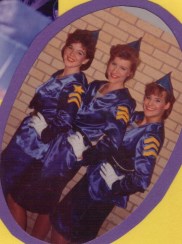
In college, I auditioned over and over to be a hostess for our annual Follies. I never did get to do it. That was tough, because I had to sit in the auditorium for chapel every day, and look at the stage where I felt so defeated.

1988_2Until I decided to stop auditioning for the thing I was never going to get and direct my club’s show, a sentimental journey through the tunes of the Andrews Sisters, which won first place. Then that space, that stage, became a symbol of power (as long as I governed my thoughts). Wounds don’t just come from romance or falls. Sometimes they come from being shut out.


When my husband changed jobs and we moved from Texas to Oklahoma, I used to sit at my picture window, gazing out while wistfully wishing to move back to a town that, if I am honest, I was miserable in. I even envisioned my own woe, creating a mental picture of the melancholy pose I struck as I sighed. I looked, in my own mind, as gorgeous as any Gothic heroine. I should have been dressed in a while linen empire-waisted gown, though in truth, I was probably covered with graham cracker goo and baby spit-up, hair going every which way.

When we left Oklahoma to go back to Texas, after two weeks I called a church deacon and begged, “Please let us come back. Please.” They said no. They said, “Look forward. Not back.” It would be a while before I understood how to do that. And did it. I had to figure it out myself, because I hadn’t really seen it before.

Ten years after her divorce, my mom still sat with her wedding album, flipping through plastic-encased portraits of her happy day, remembering a time when she was joyful, healthy, and surrounded by bridesmaids. Really, her entire adult life was spent, I believe, looking back: wishing to undo mistakes, wishing to be young and happy, wishing to have close friends.

Revisiting sites of injury was a family trait. Sometimes those sites were physical, like boyfriend’s houses, scabs, or stages. Sometimes not, though.  I could not possibly account for the hours I have spent, in my own mind, replaying scenes in which I hurt someone or someone hurt me.

But now I don’t. I just don’t go to places that hurt. I have made the conscious choice to avoid hurting myself. When I reflect on it, I think I made the decision to stop visiting hurtful places around the time I also made the decision to stop cutting myself with scissors.

I was a late comer to the cutting thing. When I was a teen, I didn’t even know that was a thing you could do to alleviate sorrow and anxiety, so I tried the pursuit of perfection and the allowance of boys defining my identity, with a bit of disordered eating thrown in for good measure. In my thirties, though, I found it. Cutting, I mean. Sometimes I escaped to the little office in my theatre classroom to grab scissors from the apple crock in which I still keep pens and pencils, and I would dig deeply into my arm. At home, I might grab a kitchen knife and lock myself into the bathroom, cutting my thighs. It burned. It hurt. And it gave me more scabs to pick at.

I don’t cut myself anymore. I am not ashamed of that chapter, I will talk about it if I am asked. But it’s not my favorite thing to revisit.

049a

There are also places I don’t visit. I have only been to my mother’s grave once, and to my father’s never (beyond the days of their funerals). It is too hard. It opens floodgates of sorrow, sorrow that is close enough to the surface of my heart that tears and heartache don’t need gravestone markers to incite them. For some, visiting those graves is a comfort, and I say, “Go. Please, and tell them I love them while you’re there.”

Churches are a no-go. Way too much hurt inflicted when my husband was in, and then out, of youth ministry. Way too many Sunday mornings when no one said hello. Way too many judgements and proclamations and “encouraging words” masking an assumption about who I am and what I need.

I tried going into the auditorium of the high school where I spent eight years building the theatre program from the ground up, and which I left because of a combative administration. The day I went there, I was laid low, emotionally tender and teary-eyed for days. So I don’t go back in there any more. I know my former students wondered why I didn’t come see their shows, they were so sweet to invite me, but I just couldn’t.

998293_10151606483607711_2070554230_nWe sold the home we spent the bulk of our child-rearing years in, I can’t drive by it, I just can’t. And the house I just sold last year, the one we built from the ground up? No way. When mail was delivered there for a month or so after our move, my husband had to go pick it up.

I don’t visit the local community theatres, not even to see shows. Those are places that have become like great big, giant triggers. Sitting in them feels like little bits of broken glass all over my skin while I am reminded of so many times of being overlooked.

Some places, some people, some memories, just hurt a little too much. Is there beauty in pain? There can be. Is there growth in pain? Often. Is there a benefit, though, in reopening old wounds, wounds that aren’t festering or infected, but are still vulnerable? Not for me. I have had to learn to stop standing at the picture window, sighing and mooning. No more drive-bys to old scenes of hurt.

Like the Fleetwood Mac song says,

“Why not think about times to come?
And not about the things that you’ve done?
If your life was bad to you
Just think what tomorrow will do.”

Everyone’s life has been bad at one point or another. I suppose we all have different ways to heal and protect.

Shielding my quiet soul means choosing where I go. For me, self care doesn’t look like spa facials and chocolate truffles. It looks like a picket fence, covered in flowering vines, protecting me from turning back. It looks like my yoga/meditation room. It looks like my yellow bicycle. It looks like screen shots of texts from my close tribe of trusted friends. It looks like writing a book instead of directing or acting a play script. It looks like my husband and children. It looks like…my life.

dandelion 2


Short and Sweet: Generations.

This morning, I find myself consumed with thoughts of my family, its history, its future. I think that, because I am watching my daughter’s body change daily as she grows this sweet, first granddaughter, nostalgia hovers close these days.

I have discovered that I am both culmination and continuation. I am the culmination of all those who came before: the immigrants who left Europe to forge a new life in America; the man who grew up in dusty Oklahoma and serenaded the most beautiful red-head in town; the couple who lived in a tent by a lake and did kitchen fox-trots; the parents who started off with such hope and faltered so devastatingly. I am also continuation: the children that my husband and I made, the family that we raised so erringly but with such love, has gone out to keep the family tree growing tall, reaching simultaneously toward sky and earth. Culmination and continuation. Wish granted.

Let’s Go Fly A Kite!

Daddy and me, 1970I believe kites are dreams. I mean, really, when you’re flying one, don’t you feel as though you’re floating alongside it, aloft like a dandelion seed, rising and falling on unseen wafts of air? I have not flown a kite in years, but I used to love to send a kite up into the air, running with the string, giving it slack or yanking it taut to keep it soaring.

My daddy loved to fly kites. When I was a kid, he would sometimes bring an armful of newspaper to the kitchen table and call me and my brothers into the room. We gathered scissors and tape; I would usually decorate the kite, and Daddy always stressed the importance of the tail. On other occasions, Daddy would see a kite at the store and on impulse, he would snap it up and take it excitedly to the cash register. This was a real splurge for us, money was always scarce. I think maybe Daddy bought kites when he was feeling discouraged and needed a lift.

Perhaps kites are prayers, too. Though always a man of faith, church was not something my daddy attended regularly. I am not sure what his personal faith journey was, I know there were some devastating hurts inflicted by well-meaning but misinformed church leaders. I know that in my own arrogant twenty-something faith years, I probably landed a few good blows, too.

Perhaps my daddy sent kites up when he wanted to connect with the Almighty;  by shifting his focus away from the heavy gravity-soaked earth under his feet and onto the vast expanse of blue sky, he could send a little whisper to God on the breeze. I like to believe that God whispered back.

The year my daddy turned fifty, I learned something new about him. While visiting us for Christmas, he and I stayed up late to chat in the living room speckled with tree-light glow, whispering so we didn’t wake my sleeping toddler. He told me, for the first time, that he had always wanted to be an Air Force pilot, it had been his aspiration throughout childhood. When he applied for the Air Force, his eyesight prevented him from being accepted into flight school, so he went to the Navy instead.

Maybe for him, kites were also Air Force jets.

Anyway, once our kite was ready, Daddy would load us three kids in the car and we’d head to a field, usually at the nearby elementary school, and we would fly our kite until it broke or darkness fell. Those are some of my favorite memories with my dad and my two brothers.

11427195_10152818410851097_4664171811351207828_nRecently, my eldest daughter, Hilary, posted a photo on Facebook of she and a friend flying kites on the beach in California. She’s another dreamer, off in L.A. pursuing a career in film, putting away doubts and only listening to voices that encourage. I love that image- sun, sand, kites aloft, and my daughter’s smile.

My daddy was not the only one who loved kites. The Chinese are credited with inventing them thousands of years ago. The Afghan people fly kites competitively. Khaled Hosseini’s novel The Kite Runner is an exquisite chronicle of a father and son who run after fallen kites.

When I taught junior high theatre, there was always a day after standardized testing when the kids took the kites they had been building in math class out to fly. The halls were filled with such laughter and excitement– flying a kite is way better than sitting at a desk doing endless formulae, and I know that flying their very own colorful creations is probably one of their favorite school memories.

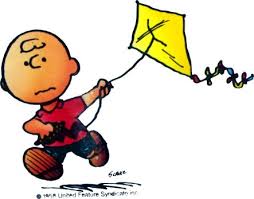
Charlie Brown

Poor Charlie Brown never could get his kite up past the kite-eating tree. Dreams denied, indeed. The classic loser can’t fly a kite.

And then there’s the classic Disney film Mary Poppins.

I always cry at the end of the movie. Somehow, the Sherman Brothers, who wrote the song for Walt Disney’s film, perfectly captured the joy that comes when you fly a kite. With its lilting melody and hopeful lyrics, a kite lover can close her eyes and remember exactly how it feels to send a kite soaring, all at once “lighter than air.” In that film, the kite is a symbol of a healing family: “Up, through the atmosphere, up where the air is clear, come, let’s go…fly a kite!” A family needs a moment when the air is clear. So does a dreamer, or a God seeker, or a middle-aged former teacher who wonders at every turn what in the world she’s supposed to be doing.

Mary Poppins kite

Life is kind of like kite-flying, I guess. Wind dictates direction, sometimes we go in ways we never envisioned. The glass-covered strings of our enemies can cut our own fragile strings and send us plummeting to earth, shattered and broken. Hopefully, a kite runner, maybe a loving family member or an attentive friend, occasionally even a random stranger, picks up our damaged kite and, with glue and tape and love, puts us back together so we can give it another go.

All this talk of wind and adventure and dreams has made me want to go kite-flying. I’d better go find tuppence for paper and string. Time to build my own set of wings.

dandelion 2