
Mary Oliver’s Poems and Sacred Trees

This morning, I awakened to a gift. A poem that my eldest child, my daughter, sent to me. It was by Mary Oliver. I read it. I was stunned. And then I was intrigued. So I decided to find some more of Oliver’s work. What followed was no less than a descent down a white-rabbit tunnel into a wonderland of beautiful words and exquisite thought. It seemed I had found a poet who spoke to my soul. It turns out Mary Oliver is also a deep-thinking, dream-driven introvert who loves nature, and she has drilled deeply into the questions of Divinity. God’s nature. God’s revelation in nature.

Unitarian Universalist minister and blogger Fred Hammond described it beautifully, and he quoted author Kathleen McTigue as well:

“Kathleen McTigue writes regarding Oliver’s theology, ‘By that word [theology] I mean not only what her poems reflect of her beliefs about God, but what they reflect about a host of other religious questions: What is holy? Who are we? What are we called to do with our lives? What is death, and how do we understand it when we turn our faces toward its inevitability? These questions matter to all of us. And the answers in Mary Oliver’s poems feel so resonant and so true…’”

These are the questions that have become the very litany of my new existence. I now have an empty nest. It’s just me and my husband and our two dogs knocking around the house. I always believed my calling to be a mom was holy. I know it was. But it’s pretty much over. Now I wonder what I am called to in this new chapter. And with each arthritic pain and new wrinkle, I am forced to turn my face toward the inevitable. My parents are gone, my husband’s parents are slowing down. Beloved aunts and uncles seem so much older. These days, my heart is tender. Tears hover behind my eyelids, waiting just out of reach for a bit of tender piano music or the sight of a mother nursing her baby to call them forth, dripping down my lined face.

I have begun to embrace the idea that I am holy, in and of myself. Not my motherhood. Not my wifehood. Not my artistry. Not my vocation. Not my voice. Not even my silence. I am all of those things. All of those things are holy. But even without them, I am holy.

tree 2

And trees are, too.

This poem moved me to tears:

When I Am Among the Trees

When I am among the trees,
especially the willows and the honey locust,
equally the beech, the oaks and the pines,
they give off such hints of gladness.
I would almost say that they save me, and daily.

I am so distant from the hope of myself,
in which I have goodness, and discernment,
and never hurry through the world
but walk slowly, and bow often.

Around me the trees stir in their leaves
and call out, “Stay awhile.”
The light flows from their branches.

And they call again, “It’s simple,” they say,
“and you too have come
into the world to do this, to go easy, to be filled
with light, and to shine.”

tree 4

I love trees. I love them. I just got back from a walk, and the photo above is where I walked: a quiet lane completely enfolded in green leaves and branches. The trees whispered in the spring breeze. Like Oliver says, trees save me. Daily. All my life.

I have always loved trees. The first tree with whom I fell in love was a locust that lived in my neighbor’s yard. My seven year old self, a neighborhood pariah, would climb into the tree and nestle in its branches, eating the little brown beans that grew in pods, watching the kids play without me from the safety of my perch.

My ten year old self adopted the tree in our new house, wedged into the V shape that just fit my scrawny behind, Beverly Cleary and Madeleine L’Engle books nourishing my lonely little soul.

Near my house there was an enormous weeping willow, and I would stand in its fronds, imagining that I was in a safe and magical world where no one could find me. I recently visited that street. Both of those precious trees were gone. I grieved.

In the yard in front of the house where my husband and I  spent most of the child-rearing years of our family, there was a giant oak tree whose leaves created a canopy outside my bedroom window. All of every spring and summer, I felt like I slept in a tree house. I kept a chair on the balcony just outside my bedroom, and when my spirit was angry or in despair, I sat in that chair and simply let the tree speak to my soul. I hugged that tree. Literally. I hugged her. And when we left that house, I had to spend time with her, saying goodbye and thanking her for taking such good care of me.

Psalm 52:8 says: “But as for me, I am like a green olive tree in the house of God; I trust in the lovingkindness of God forever and ever.” I think that oak tree in Shenandoah, Texas was a gift from the Divine One, to show Her lovingkindness for my soul.

Have you ever seen a giant tree? Maybe a California Redwood? When I visited Sydney Australia with my younger daughter, we found what I think might have been a giant gum tree in the Royal Botanical Gardens. It was stunning. I almost couldn’t walk away. I had to stroke her trunk and talk to her a bit, much to my daughter’s amusement. She’s a bit more pragmatic that her older sister, who balances her chakras and talks to trees like I do.

My daughters, my son, my husband, our parents and grandparents back and back and back have created, as have all families, forests of family trees. Roots go deeper than we can imagine, soaking up nourishment of love like water. Branches reach toward the azure sky and the vibrant sunshine as the seeds of dreams are created and carried. Sometimes there is disease. It might cause a branch to fall, or perhaps even need pruning. That is the great cycle of life that the Divine One has created and set in motion, isn’t it?

What I know today is that my walk amongst the trees fed my spirit, so will the rich poetry of Mary Oliver. Her inner monologues, as revealed in her poetry, just seem to affirm that there are other introverted and tender souls out there who are like me. God has given me my soul, Mary’s poetry, and gorgeous trees to hug. His lovingkindness is everlasting.

Why “Christian Soldiers?”


I have struggled and struggled, trying to understand how so much of Evangelical Christianity has gotten entangled with the National Rifle Association. As our country tries to process our latest mass shooting incident, and I watch devout Christians on social media circle the wagons around their guns, all the while offering “thoughts and prayers” to the families who lost loved ones, I am baffled.*

Upon his arrest in the Garden of Gethsemane, when an apostle cut off the ear of a Roman soldier, Jesus admonished him, saying in the book of Matthew, ” “Put up your sword. All who take the sword die by the sword.” And though Jesus did speak of violence to come, it was the violence of persecution and martyrdom. Not war.

But as I meditated this morning, for some reason I found myself singing an old Sunday School song:

“I may never march in the infantry,

ride in the Calvary,

shoot the artillery. I may never

fly o’er the enemy, but I’m in the Lord’s army. Yes, sir.”

There were hand motions, complete with a military salute. And I realized that somehow, over the millenia, we have equated faith with war and violence. There were the Crusades, the Spanish Inquisition, the witch trials. After World War II, and during the Communist scare of the 1960s-1980s, many Christians wove patriotism, militarism, and Christianity into a camouflage fabric. The Constitution, and particularly its Second Amendment, have been granted the same reverence as the Bible, as though both writings, penned by a group of men in the late eighteenth century, are as inerrant and Divinely inspired as the Bible itself. After the Newtown shooting in 2012, English journalist Jonathan Freedland made this observation:

“If you really want to know why the US can’t kick its gun habit, take a trip to the National Archives in Washington, DC. You don’t even have to look at the exhibits. Just study the queue. What you’ll see are ordinary Americans lining up, in hushed reverence, to gaze at an original copy of the United States constitution, guarded and under heavily armoured glass. It is no exaggeration to say that for many Americans this is a religious experience.”

https://www.theguardian.com/commentisfree/2012/dec/21/sacred-text-us-gun-habit

Image result for if jesus had a gun

I myself have tried to gently discuss the idea that the Constitution is not above needing change, that in the 200 years since it was written, the world has changed and that elements of the document that was written so long ago could use revision. For a Constitutional Believer, that is a non-starter.

And then, there’s this: somehow, many Christians have come to believe that bearing an AR-15 is a sacred right, endowed by God and sanctified by the same Jesus who told Peter to put away his sword.

How did we get to a place where we are teaching seven year olds that being a Christian is equivalent to being a private in the United States Army?

Songs like “His Banner Over Me Is Love” and “Onward, Christian Soldiers” reinforce this perception- Christians are here to do battle: battle against the people whose life choices are disagreed with, battle that requires a bump stock. We are an army, and armies need weapons.

The Armor of God that Paul wrote about in his letter to the Ephesians is this:

“Therefore put on the full armor of God, so that when the day of evil comes, you may be able to stand your ground, and after you have done everything, to stand. 14 Stand firm then, with the belt of truth buckled around your waist, with the breastplate of righteousness in place, 15 and with your feet fitted with the readiness that comes from the gospel of peace. 16 In addition to all this, take up the shield of faith, with which you can extinguish all the flaming arrows of the evil one. 17 Take the helmet of salvation and the sword of the Spirit, which is the word of God.

18 And pray in the Spirit on all occasions with all kinds of prayers and requests. With this in mind, be alert and always keep on praying for all the Lord’s people.’ Ephesians 6: 13-18.

Righteousness, faith, truth, readiness, salvation, the word of God. Paul says nothing about swords, bows and arrows, axes, slings, spears; or the modern day equivalent of handguns, rifles (bolt action or semi automatic), and shotguns.

I became truly aware of this conflation of militaristic patriotism and faith when I took a job teaching in a private Evangelical school in south Texas. I was required to lead my students in the pledge to the “Christian flag” along with the pledge to the Stars and Stripes. And though I had been raised singing about shooting the Lord’s artillery, I was flummoxed. I had never heard of a Christian flag. I felt sick. I began to really encounter this enmeshed belief system in which loyalty to America was synonymous with loyalty to Jesus. I  decided not to lead or say that particular pledge, having students do it instead while I quietly stood by. And since my eyes were opened, I have come to believe that loyalty to the Republican party is included there (I learned this when a Christian friend accused me of hating the country because I voted Democrat-the friend was not kidding). In the last two weeks, I have added loyalty to the NRA to the mix. Not for all Christians, no. But for enough.

Image result for The Christian Flag

I have found myself wondering, amongst the money that is spent on guns, how it compares to money spent on feeding the poor. For each donation to the NRA, does the Christian gun advocate donate equally to a relief organization? Maybe.

In her blog “Just a Jesus Follower,” Anna Dimmel cites the New York Times:

“The NY Times recently published an article outlining the top 10 career recipients of N.R.A. The numbers speak volumes regarding the amount of control they have ‘bought’ inside our government.

It’s just gross.” It is, Anna. It really is.

America is not God’s Chosen Nation. That was ancient Israel. We are one of many great nations. God is not wrapped in a robe of red white and blue. Jesus doesn’t wear a camo hunting jacket and red trucker cap emblazoned “Make America Great Again.”

The Divine is greater than jingoism. Jesus would not have carried an AR-15. It’s time for some American Evangelicals to remember whom they profess to serve. Even more, it’s time for the compassionate, loving Christians to speak up. They can change the conversation if they will just gird themselves in that powerful and true armor of God.

Here’s Anna Dimmel’s blog:


https://justajesusfollower.com/2018/02/22/christianity-vs-the-nra-finding-a-different-perspective-on-gun-control-and-violence/

*In the interest of full disclosure- I am what some would probably called “lapsed.” Maybe “Lost” or “Fallen.” My frustration with some of the issues I have described here, along with the church’s treatment of women, and other more personal issues, have left me unable to face organized church. But I do love God. Jesus is a friend.

An Open Letter to The Christian Left


This morning, I felt I had to leave a Facebook group that I had, for the most part, been enjoying. I joined The Christian Left based on the recommendation of a college friend with whom I had recently reconnected. We both graduated from the same private evangelical Christian university, and it’s somewhat unusual to find alumni who share at least some of my crazy Leftist leanings.

I am a Liberal. There. I said it. I said it in Montgomery County, Texas. I said it as the rarest bird in my neck of the woods.

“I am a Liberal. That means I look ahead, not behind. I welcome new ideas without rigid reactions. I care about the welfare of the people: their jobs, housing, schools, and health; their civil rights and their civil liberties”

The above is a meme I have been seeing floating around in the cyberspace world, I have no idea whom to credit. It pretty well sums up how I see myself.

Most of my family is pretty Conservative- the Tea Party movement resonates for them. My neighbors as well. My husband wouldn’t let me put a Hillary for President sign in the yard for fear the house would be egged. My Obama campaign signs got ripped in half in 2012. I have cringed at the ugly  faces contorted with anger seen at Trump rallies, cried at the Nazi salutes being thrown. Shuddered at David Duke’s endorsement of Trump and his refusal to repudiate it. I have shaken my head at Betsy DeVos’ agenda and Paul Ryan’s sycophancy.

I have called and mailed and e mailed my senators and representatives, at both state and federal levels (Unfortunately, Ted Cruz thought I was writing in support and put me on a mailing list. I called his office pronto).

We donate money to Public Radio/TV, a local theatre, an animal shelter, a global humanitarian organization, an environmental advocacy group, and Planned Parenthood (because women need resources and if abortions are going to happen-and you’re blessedly naive if you think they aren’t- they need to be safe).

I really do try to walk, not just talk, my belief system. And I feel pretty isolated. So I was thrilled to learn there might be a Facebook community that shared my ideals and my open-hearted approach. For a month, I have been seeing a daily scripture, usually about caring for the less fortunate, and seeing mostly useful news stories about relevant issues.

Until this week.

The POTUS had his physical. And the one page where I thought it would be safe to read the comments became a mixture of sarcasm, body shaming, name calling, and hate.

Do I believe the official height and weight that they say Trump is? No. Does it matter? No. And I know some people would say, “It’s just one more lie on top of so many. It shows a pattern.” Yeah, I get that. But when there are two posts by The Christian Left in one twenty four hour period about his weight, and this photo leads:Image may contain: one or more people and text

When the comments are:

  • if that is true then I am the virgin Mary
  • Sorry, he ate the moon, it looked like a big mac
  • What, they are referring just to his ass?

Then we have a problem. I, along with others, tried to call TCL out on it. We tried to point out that there are bigger issues, even bigger lies, on which to focus. That didn’t go so well:

  • “Kimberly, take a chill pill…Venting is healthy. So many of us feel hopeless with the nuclear button threat. Too bad Kimberly only sees things her way. Bless your teeny tiny heart Kimberly, may it grow like the Grinch’s did.” That’s from a nice lady named DeeAnn, who, though she has never met me says I have a tiny and judgemental heart.

It’s no wonder we are not making headway, Liberals.

A third post on TCL’s page within the same time frame shows a photo of Trump with a signature and the caption “I know how to write my name!” Of course he does. This particular post was the intellectual equivalent of blowing a raspberry or calling “Nanny nanny boo boo.”

Where’s the smart and mature resistance, folks?

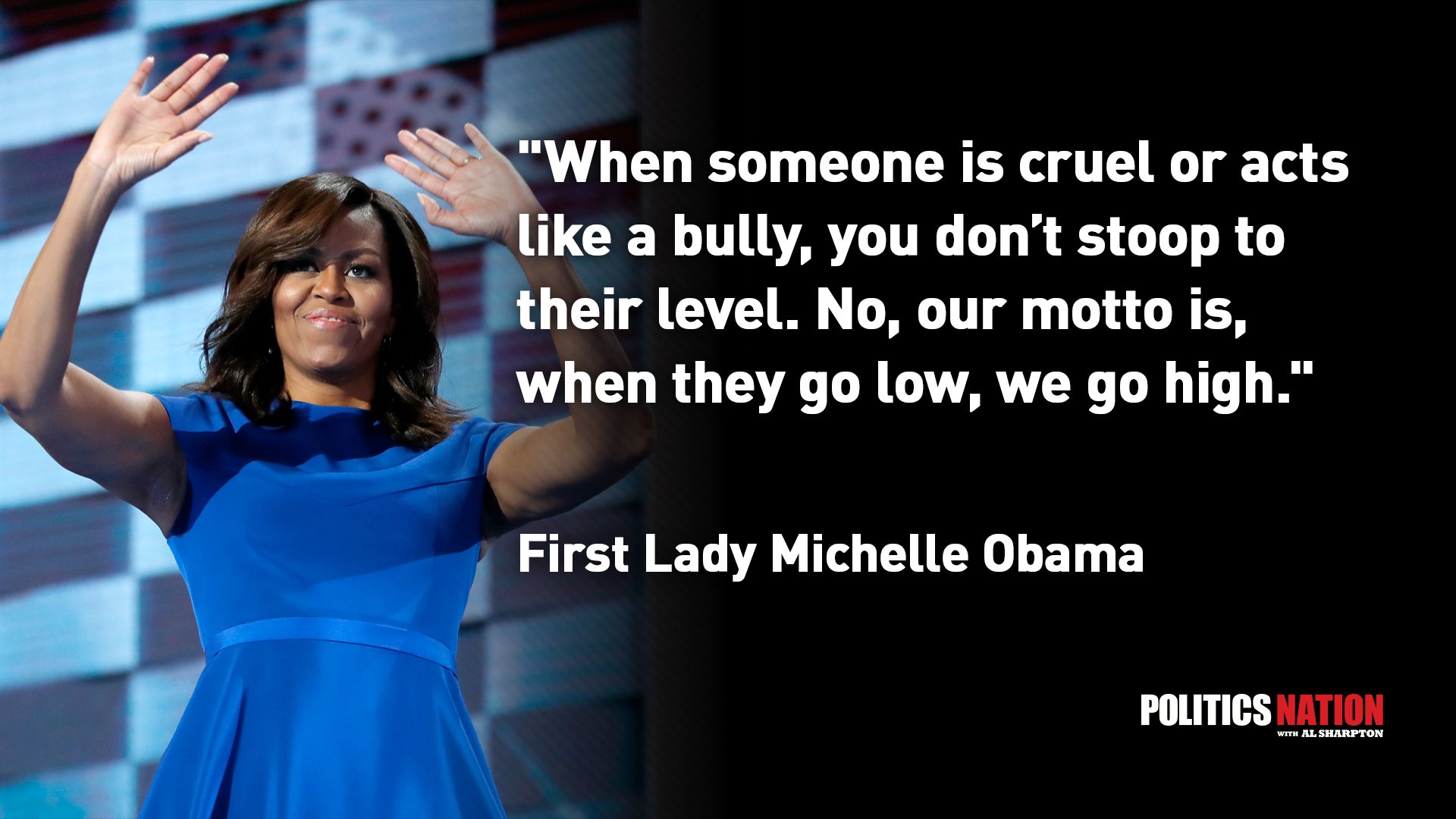
I have held such hopes that the left side would adhere to the former First Lady’s exhortation. That we could, by taking the high road, show all those haters at the white supremacist rallies and Tea Party functions that love wins (Thanks, Rob Bell).

Alas, that’s not the case. So I left the group, unliked the page, and headed over to my BFF (in my fantasy life) Brene’ Brown’s page. At the top? This quote from Rev. Martin Luther King, Jr:

“There comes a time when silence is betrayal.”

Truth. Silence is a betrayal. But we must choose our words wisely. Me? I will speak to injustice and call out cruelty, whether it’s from the Left or Right. I will speak the truth in love (Ephesians 4:15). I really hope my like-minded brothers and sisters will too.


Between Shame and Ovation (Thoughts From the Wife of a Former Texas Youth Minister)

Sunday night, after a quiet day of reading and watching television while my husband stayed tucked in bed fighting off a cold, we watched the news together, and looked on in horror and recognition as a story broke about a pastor in Tennessee who had confessed to the 1998 sexual assault of a seventeen year old girl in his youth group. The news program showed footage of Andy Savage apparently remorseful, as he confessed to a megachurch audience. They gave him a standing ovation.

A standing ovation.

I have something to say about all this.

In 1999, living in the very same town (I currently live just five minutes from the church where Savage was a youth minister), my husband was also a youth minister. Though he doesn’t specifically remember Andy Savage, it’s likely they at least attended the same monthly youth minister luncheons that were held at the various churches around our town.

And in October of 1999, my husband stood in front of the congregation and confessed, at three different church services, a sex addiction.

There was no standing ovation.

Thankfully, he never touched a member of his youth group. His struggle was with the fantasy world of pornography and adult bookstores, not with the flesh and blood reality of teenagers.

I will never, as long as I live, forget the glare of the lights and the wide eyes of the church members as we stood on the stage, hand in hand, and Travis told everyone his deepest, darkest secret. This was a move that was required by the church leadership if he wanted to receive a severance salary.

Unlike Andy Savage, whose church leadership demanded silence, both of him and the young lady he abused, our church leadership insisted on full and public disclosure.

I don’t think it is coincidental that last week I downloaded a double episode of Oprah’s Super Soul podcast, with guest Brene’ Brown . The universe was getting me ready to see this story on the news and in my social media feed. Last night, on the way home from work, Brene’ spoke her mantra to Oprah: “You share with people who earn the right to hear your story. It’s an honor to hold space for me when I am in shame.”

As my husband stood in the sanctuary and, in a broken voice, told 2,000 people, most of whom were complete strangers, his darkest struggle, I felt like we had been raped. It was as if our clothes had been ripped from us, and we stood bare for all to see. My children also had to bear the burden of the sidelong (or worse, pitying) looks that were sent their way over the next few months as we struggled to keep attending the church where every room, every person, and every worship service sent us spiraling back into shame. Two years later, when I sat in a therapist’s office and told her this story, she was horrified and told me, in no uncertain terms, that we had been victims of profound spiritual abuse. I have often wondered how many men sat in the pews that morning and breathed great big sighs of relief that their own garage stash or computer files hadn’t been found yet. My husband got to be the whipping boy, the sacrificial lamb, for them.*

Is it any wonder I can’t do church anymore?

There has to be a middle place- somewhere between public shaming and standing ovations. A place where healthy confession is possible, accountability is attainable, and healing is administered for all.

I am beyond thankful that my own husband didn’t ever actually touch a kid in his youth group. We have a close friend, A.,  for whom that was not the case. Earlier in our church work, Travis was compelled to share his struggle with a fellow youth minister who, it turned out, was crawling a similar path. They went to the same support group together. A. didn’t come out unscathed, either. He molested a youth group member.

There’s a lot to think about here: impossible standards of perfection that set young men up for deep, internal sexual struggle; spouses who suffer in silence as they try to raise children and create the model home, knowing that they dare not speak a word because their family’s very livelihood depends on maintaining the veneer of holiness; how to maintain accountability that is safe for both ministers and their charges.

But standing ovations? No. Andy Savage has to make this right with a humble apology to Jules Woodson. She needs healing. Savage and the church leadership must stop making excuses and hiding behind the passage of time. Because I know that if my own experience is any indication, 1998 can feel like five minutes ago. Shame can rear its ugly head at any moment and utterly incapacitate you. I hope Woodson gets the love and joy she deserves. I hope Andy Savage can move forward in honesty. I hope his wife has courage and a couple of love warriors** by her side.

And I hope that his current congregation learns how to support, but not idolize, the penitent minister. I hope they know who the victims are and I desperately hope that they have compassion and love for all concerned.

May the Divine One breathe healing and peace on all of these broken people. And may we all know that we can be broken and healed, as well as being instruments of grace and healing.

*There was one particular family who sat in our shame with us. They listened as we cried, watched our kids while we went to therapy, and never gave us that pitying look. They know who they are, and they are blessedly still in our lives. Most folks just ignored us or tried to pretend nothing weird had happened. I get it- once you’ve seen someone’s nakedess, it’s hard to go back.

**Love Warrior is a phenomenal book by Glennon Doyle. A recovering addict, Doyle was married to a sex addict herself. She knows this journey. I highly recommend this book, which was fortuitously and prophetically given to me this Christmas by my eldest daughter.

Losing My Religion

candle

It’s the day after Christmas. I am sitting in my quiet house, my sweet husband is napping, my eldest daughter and her fiancee have left for a movie, my son is at work, and my youngest is across the world. It has been a wonderful Christmas- everyone is healthy (I didn’t fall and injure myself severely- just one small second degree burn from a candy-making fumble) and happy, and very much in love with their significant other. I don’t feel any post Christmas blues, but the holiday’s passing has left me feeling reflective about one very specific thing: my vanished faith.

I do understand the actual origins of Christmas- Yule and Saturnalia, Pope Julius I’s decision to create a celebration of Jesus’ birth and using the conveniently placed Solstice celebrations to do so, the Puritans’ refusal to acknowledge the holiday (it was against the law to celebrate Christmas in Boston from 1659-1681), its absence in America throughout the 18th century, then its resurgence in the 19th with the publication of Washington Irving and Charles Dickens’ novels.

Historically, Jesus is really not “The Reason for the Season.” But in contemporary America, in Texas, Christmas is very much about celebrating the birth of Jesus.

But not for me.

Amy-Grant

Recently, I had the pleasure of attending Amy Grant and Michael W. Smith’s Christmas concert at the Cynthia Woods Mitchell Pavilion here in the Houston area. I was so excited! It was a chilly night (a rare occurrence in a Houston December), and poor Amy had come onto the outdoor stage in an emerald sleeveless gown. She spent most of act one wrapped in a blanket, and changed into jeans, boots, and a quilted parka at intermission. Smitty was in a suit, and playing pretty vigorously at the grand piano, so he seemed to fare better in the chilled air. I loved it. They sang back to back renditions of “Jingle Bells” (Smitty sang the Perry Como arrangement, Amy the Streisand), “The Christmas Waltz,” and “Rockin’ Around The Christmas Tree.” I have been listening to these two sing Christmas songs since I was 18 years old, and it was like being home.

But the mood changed in the second half. It became more tender, more reflective, more…worshipful. In this half, Amy sang “Heirlooms” and “Breath of Heaven.” Smitty led a sing along. But this was not a sing along like happens at your child’s elementary school PTO program, with “Rudolph” and “Santa Claus Is Coming To Town.” This was “Hark the Herald Angels Sing” and “The First Noel.” The mood became holy. And I couldn’t sing. Clearly, the audience was worshiping, and I knew that to lend my voice would be inauthentic. Counterfeit. It was beautiful, and I felt alien. Throughout the remainder of the concert, I teared up several times; and when the first notes of “Friends” played in the encore, I began to really cry…when the lights went up, I found I couldn’t talk, I could barely hold it together and my sweet husband held me while I wept, truly wept.

Christmas is often a time for heavy-heartedness- that’s not news to most adults (and a few kids). We grieve for lost loved ones. We mourn passing time. I am a little melancholy this year. But it’s not really nostalgia for my childhood Christmases (which were spotty, to say the least). It’s not even nostalgia for the holidays for when my kids were little.

My grief is for my lost faith.

I no longer believe in the Christian faith. Not because of “hypocrites” or the times when God hasn’t answered prayers. Not because of the insanity of millionaire ministers or the rampant suffering and injustice in the world.

I can’t believe a virgin birth. I just can’t. Nor can I believe that a dead man rose and walked after three days entombed. And I can’t force myself to sit in a sanctuary and recite the Nicene Creed or sing hymns (or praise and worship songs) that strike me as so very, very false. It would be, for me, fraudulent, and an insult to the sincerity of the Christians who find such joy in their faith.

I believe in the teachings of Jesus, wisdom of the Proverbs, the passion and pathos of the Psalms. But I cannot accept that many of the writings of the apostle Paul were meant to be followed verbatim, by all humans, no matter gender, culture, and time, for ever and ever amen. I know enough to know that what we have as the Holy Bible was passed around, rewritten, interpreted, and adapted for 300 years before finally being codified. How can it possibly be infallible?

Unusual-Christmas-Trees uses

But secular Christmas seems so empty.

How does one recover from lost faith?

When I posted on Facebook that my thoughts, not prayers, were with the victims of the French terrorist attacks, a long time friend (who is not a person of faith) sought me out two days later to tell me, in person, that that made him sad. That he sensed that the loss of my faith was a grief to me. How profound is it that it was an agnostic to express sorrow over this loss?

That he has expressed more kindness over my loss than nearly any Christian in my acquaintance is also profound. I think I am a pretty big disappointment to a lot of people.

Most days, I don’t really give it much thought. I don’t miss church, not even a little bit. I think years as a minister’s wife, privy to the inner workings of church politics, cured me of ever wanting to belong to a church again. American Christianity has become a frightening place, full of fear and politics.

broken_cross_by_cantabrigian

In her book Quiet, Susan Cain describes the dilemma of introverts (of which I am most definitely one) trying to participate in American Evangelicanism: ” Contemporary Evangelicanism…emphasizes building community among confirmed believers, with many churches encouraging (or even requiring) their members to join extracurricular groups organized around every conceivable subject- cooking, real-estate investing, skateboarding.” She meets with a man who struggles with his introverted nature, and can’t find the place where he can worship, commune, and serve. I get that. In my last attempts at finding a church home, all I wanted was a place where I could have a few real, genuine friends and contemplative, thoughtful worship, preferably far, far away from LED smart lights and Jumbotron screens.

Oh, and by the way, I still believe in God.

So I try to use walking or yoga time to reconnect with the Divine. In my solo worship time, I have learned that God is also Goddess. That trees and animals carry a bit of the Divine spark. That literature and music do as well. I have learned that kindness can be found and is often practiced by the most unexpected people: the tattooed, gypsy “heathen” is often more benevolent than the most polished Evangelical.

Years ago, when I confided to two of my aunts (on my mom’s side) that I had found myself in a desert place, they assured me that if I was just patient, that God would lead me out of the desert. I don’t feel arid anymore, and that’s a blessing. But I don’t feel Churched, either. I feel like I am in a quiet forest, with a beautiful lake. Pretty alone, but with something Divine whispering to me. Maybe that’s enough.

Merry Christmas, friends.

Let’s Go Fly A Kite!

Daddy and me, 1970I believe kites are dreams. I mean, really, when you’re flying one, don’t you feel as though you’re floating alongside it, aloft like a dandelion seed, rising and falling on unseen wafts of air? I have not flown a kite in years, but I used to love to send a kite up into the air, running with the string, giving it slack or yanking it taut to keep it soaring.

My daddy loved to fly kites. When I was a kid, he would sometimes bring an armful of newspaper to the kitchen table and call me and my brothers into the room. We gathered scissors and tape; I would usually decorate the kite, and Daddy always stressed the importance of the tail. On other occasions, Daddy would see a kite at the store and on impulse, he would snap it up and take it excitedly to the cash register. This was a real splurge for us, money was always scarce. I think maybe Daddy bought kites when he was feeling discouraged and needed a lift.

Perhaps kites are prayers, too. Though always a man of faith, church was not something my daddy attended regularly. I am not sure what his personal faith journey was, I know there were some devastating hurts inflicted by well-meaning but misinformed church leaders. I know that in my own arrogant twenty-something faith years, I probably landed a few good blows, too.

Perhaps my daddy sent kites up when he wanted to connect with the Almighty;  by shifting his focus away from the heavy gravity-soaked earth under his feet and onto the vast expanse of blue sky, he could send a little whisper to God on the breeze. I like to believe that God whispered back.

The year my daddy turned fifty, I learned something new about him. While visiting us for Christmas, he and I stayed up late to chat in the living room speckled with tree-light glow, whispering so we didn’t wake my sleeping toddler. He told me, for the first time, that he had always wanted to be an Air Force pilot, it had been his aspiration throughout childhood. When he applied for the Air Force, his eyesight prevented him from being accepted into flight school, so he went to the Navy instead.

Maybe for him, kites were also Air Force jets.

Anyway, once our kite was ready, Daddy would load us three kids in the car and we’d head to a field, usually at the nearby elementary school, and we would fly our kite until it broke or darkness fell. Those are some of my favorite memories with my dad and my two brothers.

11427195_10152818410851097_4664171811351207828_nRecently, my eldest daughter, Hilary, posted a photo on Facebook of she and a friend flying kites on the beach in California. She’s another dreamer, off in L.A. pursuing a career in film, putting away doubts and only listening to voices that encourage. I love that image- sun, sand, kites aloft, and my daughter’s smile.

My daddy was not the only one who loved kites. The Chinese are credited with inventing them thousands of years ago. The Afghan people fly kites competitively. Khaled Hosseini’s novel The Kite Runner is an exquisite chronicle of a father and son who run after fallen kites.

When I taught junior high theatre, there was always a day after standardized testing when the kids took the kites they had been building in math class out to fly. The halls were filled with such laughter and excitement– flying a kite is way better than sitting at a desk doing endless formulae, and I know that flying their very own colorful creations is probably one of their favorite school memories.

Charlie Brown

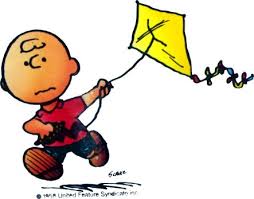
Poor Charlie Brown never could get his kite up past the kite-eating tree. Dreams denied, indeed. The classic loser can’t fly a kite.

And then there’s the classic Disney film Mary Poppins.

I always cry at the end of the movie. Somehow, the Sherman Brothers, who wrote the song for Walt Disney’s film, perfectly captured the joy that comes when you fly a kite. With its lilting melody and hopeful lyrics, a kite lover can close her eyes and remember exactly how it feels to send a kite soaring, all at once “lighter than air.” In that film, the kite is a symbol of a healing family: “Up, through the atmosphere, up where the air is clear, come, let’s go…fly a kite!” A family needs a moment when the air is clear. So does a dreamer, or a God seeker, or a middle-aged former teacher who wonders at every turn what in the world she’s supposed to be doing.

Mary Poppins kite

Life is kind of like kite-flying, I guess. Wind dictates direction, sometimes we go in ways we never envisioned. The glass-covered strings of our enemies can cut our own fragile strings and send us plummeting to earth, shattered and broken. Hopefully, a kite runner, maybe a loving family member or an attentive friend, occasionally even a random stranger, picks up our damaged kite and, with glue and tape and love, puts us back together so we can give it another go.

All this talk of wind and adventure and dreams has made me want to go kite-flying. I’d better go find tuppence for paper and string. Time to build my own set of wings.

dandelion 2

And the winner is…

Astros ring

It’s baseball season! And since I live in Houston, the home of the current World Champ Astros, for whom I just bought a new team shirt and am anxiously awaiting the chance to go to a game at Minutemaid Park,  I find myself contemplating the concept of sport. Of Competition. I wonder how much we Americans are conditioned to Competitiveness and how much is innate. Clearly, some element of Competition has existed in humanity before there was even organized society. Cain Competed with Abel for Adam’s esteem, spilling blood to be the favorite. The Greeks held magnificent athletic and artistic Competitions in the original Olympic games. Who was Alexander but the most Competitive general to lead an army?

So I don’t really have a problem with Competition. It is a necessary force that pushes humanity to make new discoveries, chart new frontiers, and achieve excellence.

But sometimes I wonder why we have seemingly made everything here in America about being the best. We give trophies and tiaras to four year olds who prance and priss better than the other little girls. We pit students against each other in spelling bees in first grade so that the adept learners can lord it over the ones who are a little (or a lot) behind. We award trophies to kids for being on a sports team, making the trophy the desired end, rather than emphasizing the lessons learned about sportsmanship and personal physical fitness.

It is a mentality that permeates every single aspect of American life. We rate our movies according to top box office gross every Monday morning. We look at the cars next to us at the red lights and either pat ourselves mentally or grit our teeth in envy. We slave endlessly (or pay yard workers to) so that we might put that “Yard of the Month” sign in our front yards. Most women eyeball each other in the mall, comparing rear ends, wrinkles, and wardrobes. We brag about our kids’ grades on bumper stickers. It’s in our schools, our churches, our businesses, our neighborhoods.

biblebowl

Even when the cause is worthwhile we compete. Weight loss competitions abound in businesses. Companies use competition as a marketing tool, cloaking it in contests for charity. For goodness’ sake our kids even compete for medals to see who can read the Bible best (how in the world we American Evangelicals could have imagined that children showing each other up is a Jesus thing is just incomprehensible to me)!

So no wonder we Americans believe we live in THE BEST COUNTRY IN THE WORLD! Most of us have never visited any other country, but our Competitive conditioning tell us it must be so. That ideology was a deciding factor in our most recent presidential election. Competition, not competence. Supremacy over alliance.

make-america-great-again_a-G-14251339-0

I don’t think I really am very Competitive by nature, though I think growing up in American culture can impart a pretty fierce dog-eat-dog mentality in all but the the most passive . I could never enjoy the fierce push to win at team sports, it seemed a silly waste of mental energy to me. When we had to shake hands and say “Good Game” I just wanted to make friends with everybody. I didn’t enjoy the All State Choir audition process in high school. I enjoyed the singing, but not watching some girls cry whose names were not called out. When our class elected its top ten most popular senior girls, I was #12. I watched as girls strategized and agonized about getting on that list, and I could not have cared less about that vote. I was surprised I got as close as I did. One of the top ten boys, Kevin R., told me in my yearbook that I could have been so popular if I had just tried a little harder. As a young adult I couldn’t have cared less about having better stuff than my peers. Still don’t.

As a theatre teacher, I found myself immersed in the arts, and Competition was probably one of my least favorite aspects of the job. Year after year I watched my students create beautiful work onstage and backstage. They were full of pride in their accomplishment. They gloried in the story they had told and they knew they had learned and grown in their craft as well as in their humanity. Then the trophies and medals got handed out and the kids without gold sparkly things suddenly doubted everything they thought about the art they had created. As a director, I had begun to start thinking cunningly, plotting for a win rather than for learning. Principals like it when you can set a trophy on their desks.

Irony of ironies, now that I am no longer a full time theatre educator, I serve as a judge at those very competitions. I go into those days with the goal of teaching and edifying the kids. Most of my judicial colleagues do, too.

I did discover that once the competitive element of trophies was introduced into my local community theatre stomping ground, much of my joy in that hobby was lost. I don’t get involved any more. I guess I have had one too many conversations with people who introduce themselves with their number or trophies, or who find ways to work their victories into conversation.

I am all for excellence. Anyone who knows me well knows I do not tolerate laziness or mediocrity. I used to lay that burden on others. I held everyone to my standards. Then I let go, and just held myself to a constant and unrelenting expectation of quality. That exhausted me. Through my practice of yoga, I have learned that winning has its place, but so does failure; that excellence is a worthy goal, but sometimes relenting and just being is just as worthwhile.

blue-ribbon

I envision a world where kids play on rotating sports teams, drawn by lotto. Everyone works out and plays together and switches teams to make new friends and team parties at the end of the season include the whole league in one great big bouncy castle. The top spellers help the ones who are having a hard time. The beautiful popular girls hang out with the regular girls doing stuff completely unrelated to fashion, makeup, and boys. Neighbors come together to help each other with their yards. Plays are not pitted against each other in UIL, so that students and directors can come together and share their work and inspire each other without worrying about medal count, and Americans take the time to learn about all the beautiful countries and societies that populate our planet, appreciating cultural and religious diversity without feeling somehow disloyal to the States.

I may not be the thinnest or most beautiful woman, most talented performer, best mom, winning cook, or most decorated high school director. Fortunately, I now know (at least 80% of the time) that it just doesn’t matter. What I am is a human being discovering her own path, knowing that her path is not a race track. There is no medal for winning at the end. There is only the love we leave behind as our legacy, and there’s no blue ribbon for that.